World Pet Obesity Association
Advancing clinical obesity care for pets worldwide.
WPOA advances evidence-informed standards, education, research, and clinical tools to help veterinary teams recognize, diagnose, treat, and monitor clinical obesity as a chronic disease in companion animals.
New in JAVMA
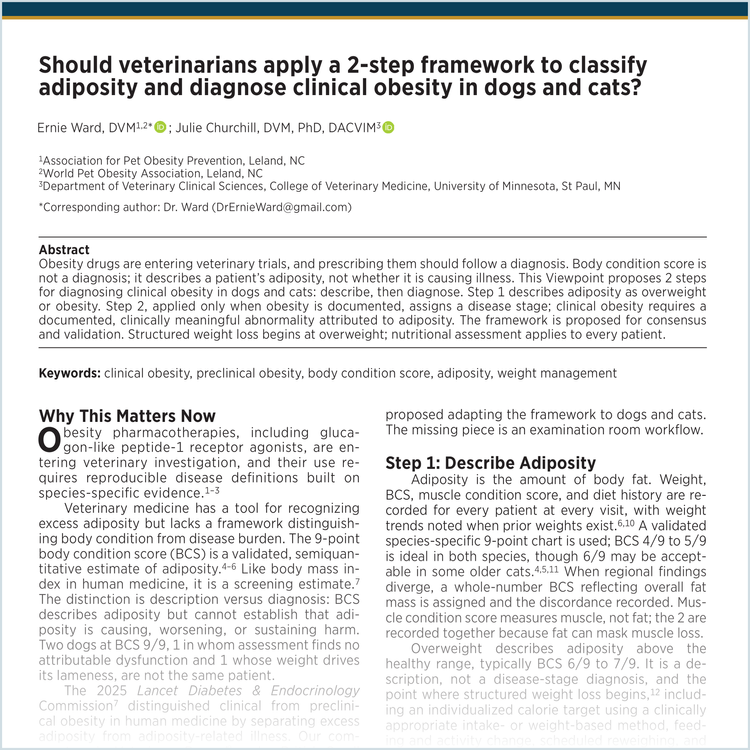
Published online · October 2026A 2-step framework to diagnose clinical obesity in dogs and cats
A body condition score shows how much fat a pet carries, not whether that fat is causing harm. A new peer-reviewed Viewpoint by Ernie Ward and Julie Churchill separates the two: classify adiposity first, then use the Three A’s to diagnose clinical obesity.
Happening now
Two surveys open through December 31
Clinic survey
Collect October 1 – December 31, 20262026 Veterinary Clinic Pet Obesity Prevalence Survey
Pick one full day, two days, or one week and record weight and a veterinary-assessed body condition score for every eligible dog and cat seen. Run by the Association for Pet Obesity Prevention; participating clinics receive early access to the findings.
Register your clinicOpinion survey
Open now · Closes December 31, 20262026 Pet Obesity and Nutrition Opinion Survey
APOP’s annual survey of how pet owners and veterinary teams see pet weight, body condition, feeding, and weight management. Anyone can take it, and clinics are encouraged to share it with their team and clients.
Take the opinion surveyNew communication standard
2026 Pet Obesity Communication Guidelines
Pet-first language, the four clinical terms, body condition over weight, and respectful images and stories, for veterinary teams, journalists, marketers, researchers, and pet owners. Published by the Association for Pet Obesity Prevention; WPOA uses and recommends them.
Clinical Focus
What is clinical obesity?
Clinical obesity describes excess adiposity accompanied by clinically meaningful abnormalities plausibly attributable to adiposity. It moves the conversation beyond appearance or body weight alone and toward a chronic medical condition that can be assessed, treated, and monitored.
WPOA supports veterinary teams with clearer clinical language, practical assessment resources, treatment guidance, and standards designed to improve long-term patient care.
More precise clinical language
Distinguishing overweight, obesity, preclinical obesity, and clinical obesity so body condition describes adiposity without automatically defining disease.
Better assessment
Using the Three A’s: Adiposity, Abnormality, and Attribution, supported by clinical history, physical examination, and relevant diagnostic findings.
Treatment-focused care
Supporting nutrition, monitoring, communication, long-term care, and evolving treatment approaches.
Multilingual Assessment Resources
Body and muscle condition charts for veterinary teams
Access WPOA Body Condition Score and Muscle Condition Score charts for clinical assessment and client communication. Multilingual downloads are available for selected species and chart types.
Available resources: body condition charts for dogs, cats, rabbits, and horses, plus canine and feline muscle condition resources. Translation availability varies by species and chart type.
Our Mission
Advancing global standards
The World Pet Obesity Association advances global standards for clinical obesity care by improving disease recognition, supporting more precise diagnosis, strengthening treatment, and promoting consistent research, education, monitoring, and communication.
Tools and Initiatives
Practical resources for veterinary care
Explore clinical tools, assessment guidance, and opportunities to contribute to global pet obesity research.
Calculators
Calorie and Weight-Management Tools
Energy estimation, feeding guidance, ideal body weight, walking energy, and weight-management planning resources.
Open calculatorsAssessment
Body and Muscle Condition Assessment Guide
Clinical guidance for using Body Condition Score and Muscle Condition Score together to assess, document, and discuss body composition.
View assessment guideExternal Research Opportunity
APOP 2026 Pet Obesity Prevalence Survey
The Association for Pet Obesity Prevention, an independent nonprofit organization, conducts this clinic-based survey of body condition and weight trends in dogs and cats.
Visit APOP to participateSubscribe
Subscribe to WPOA Updates
Receive updates on clinical obesity resources, assessment charts, global pet obesity data, research opportunities, and educational events.
Collaborate
Work with WPOA
Contact WPOA about education, research collaboration, clinical resources, survey participation, organizational partnerships, or media inquiries.