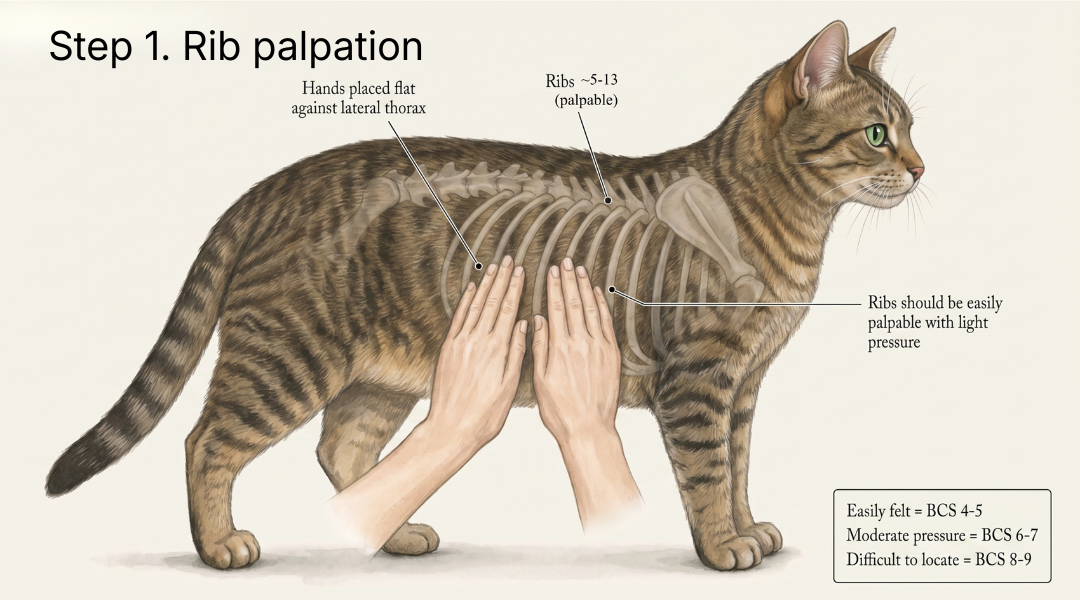
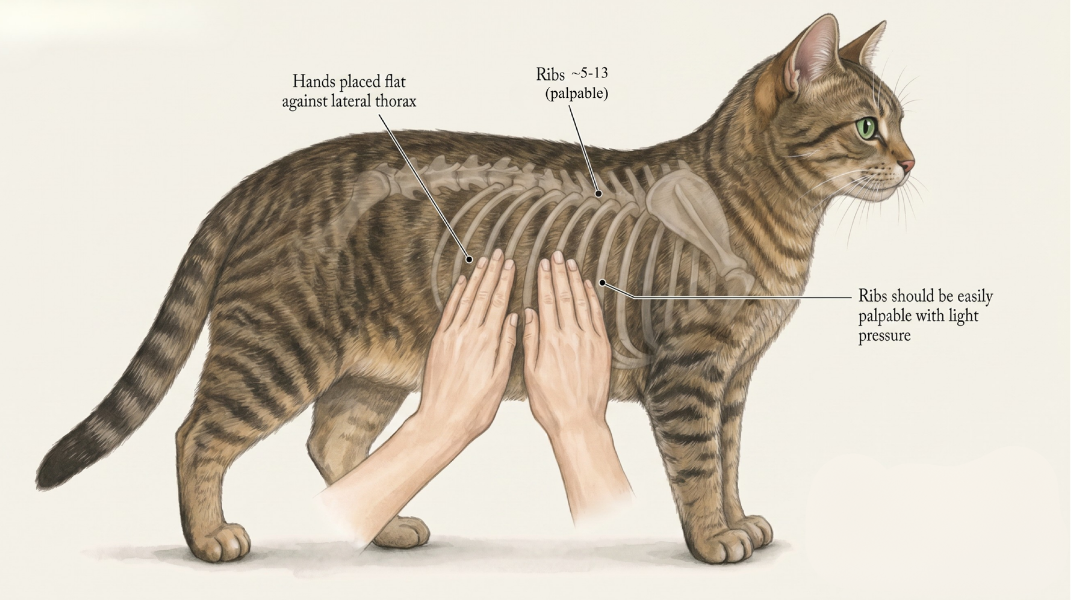
Illustration showing how to palpate a cat's ribs, with hands placed flat against the side, examining ribs numbered 5 to 13, indicating they should be easily palpable with light pressure.
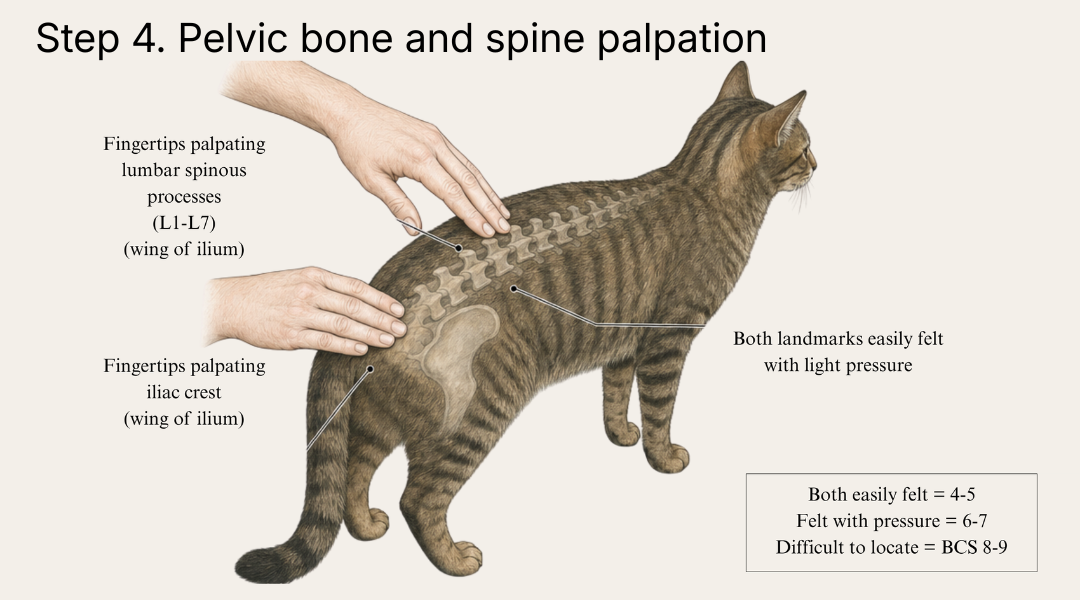
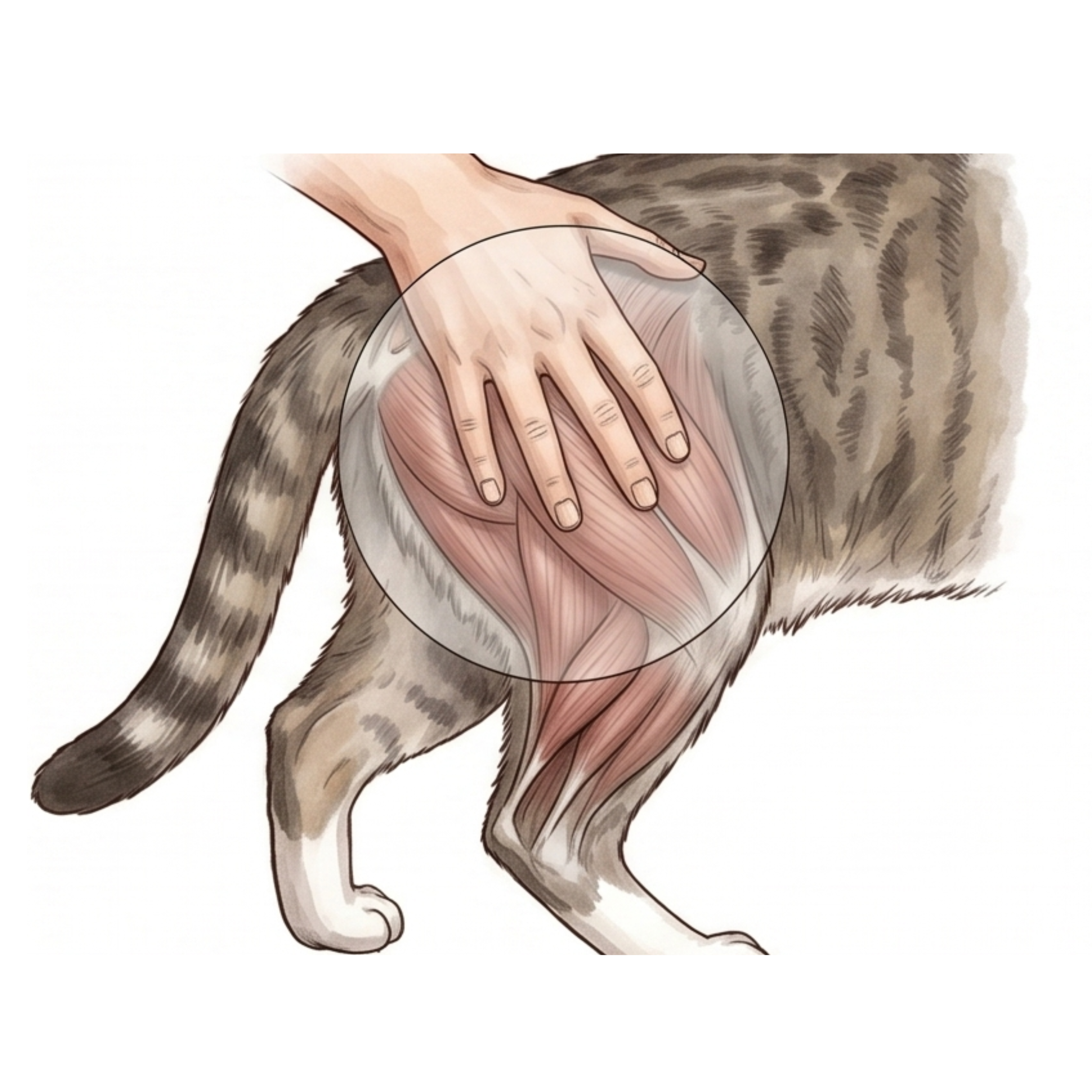
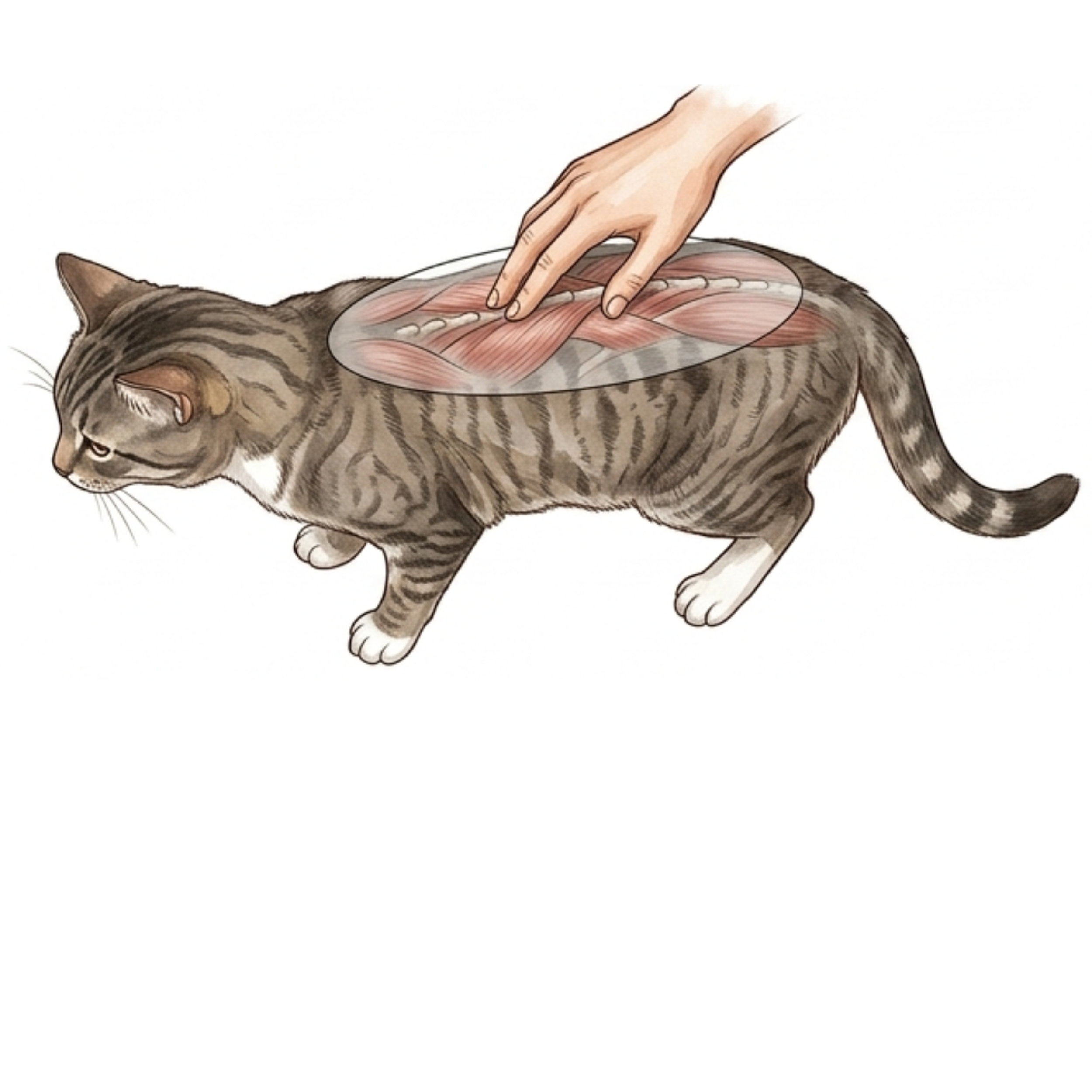
Illustration of a cat with fingers palpating lumbar spinous processes and the iliac crest to locate pelvic landmarks, with annotations indicating light pressure points and difficulty levels for palpation.
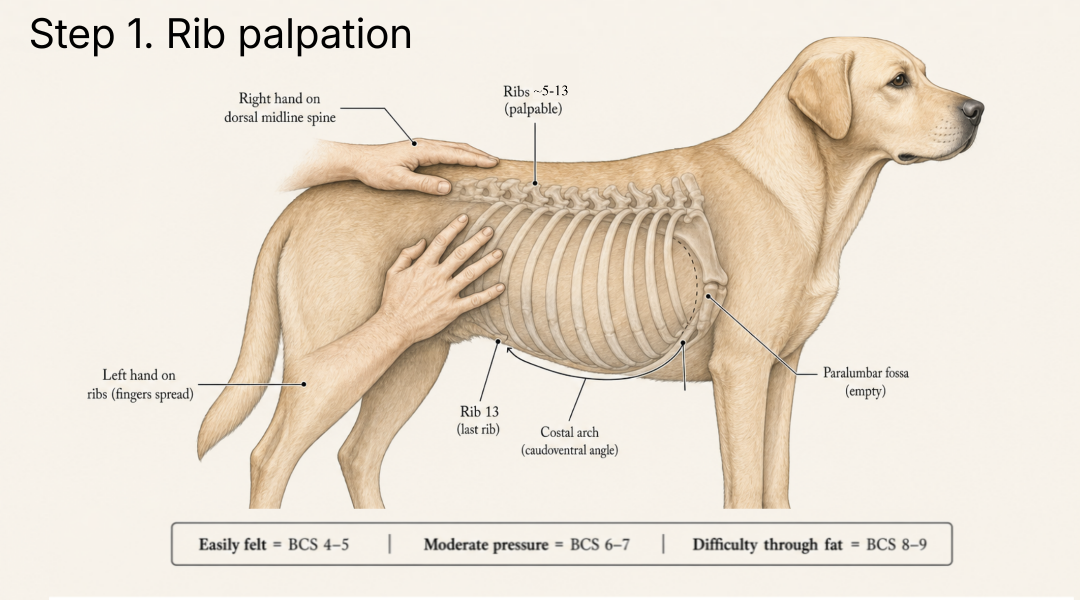
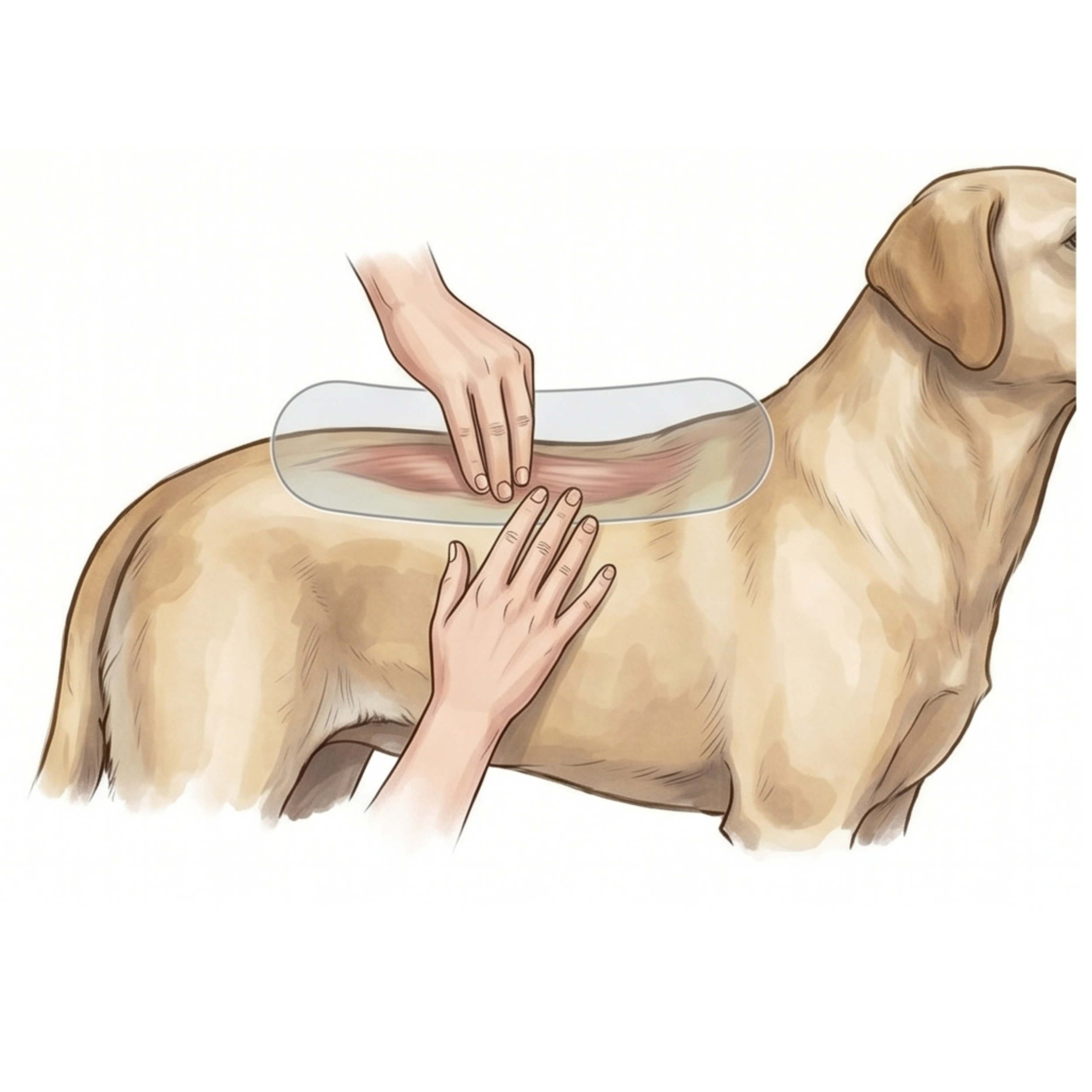
Diagram showing how to palpate the ribs of a dog, with hands placed on the dog's side and labeled ribs, sternum, and bones.
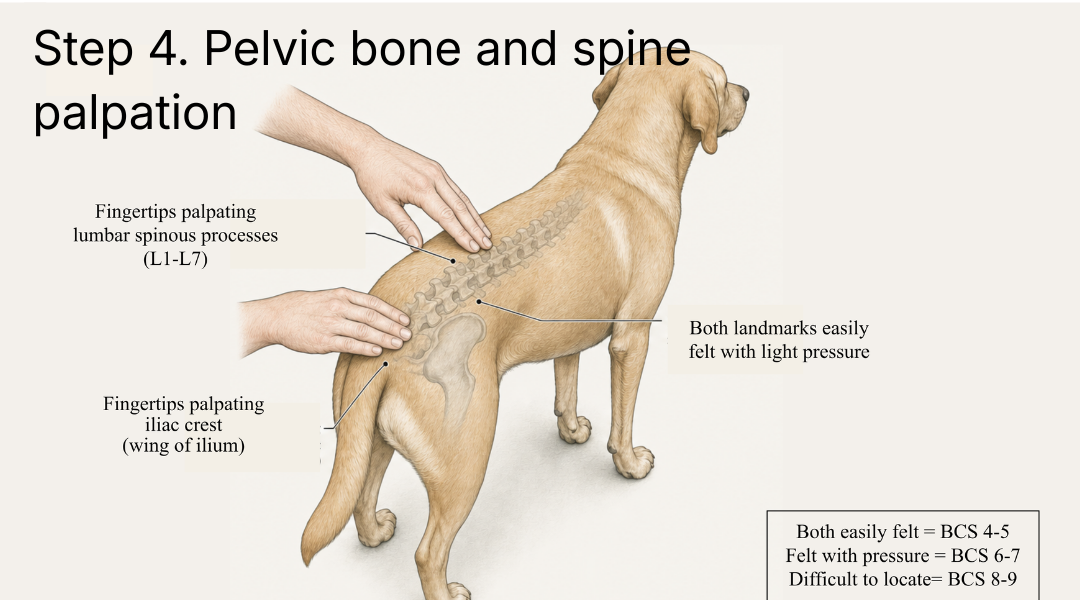
Diagram showing a dog with labels indicating palpation points on the lumbar spine and iliac crest for pelvic bone and spine palpation. The illustration highlights finger placement and pressure levels for palpation. Text explains the step and how to locate landmarks.
Illustration showing a person performing a feline thoracic examination, with hands placed flat against a cat's lateral thorax, highlighting ribs that are palpable around 5-13. Ribs should be easily palpable with light pressure.
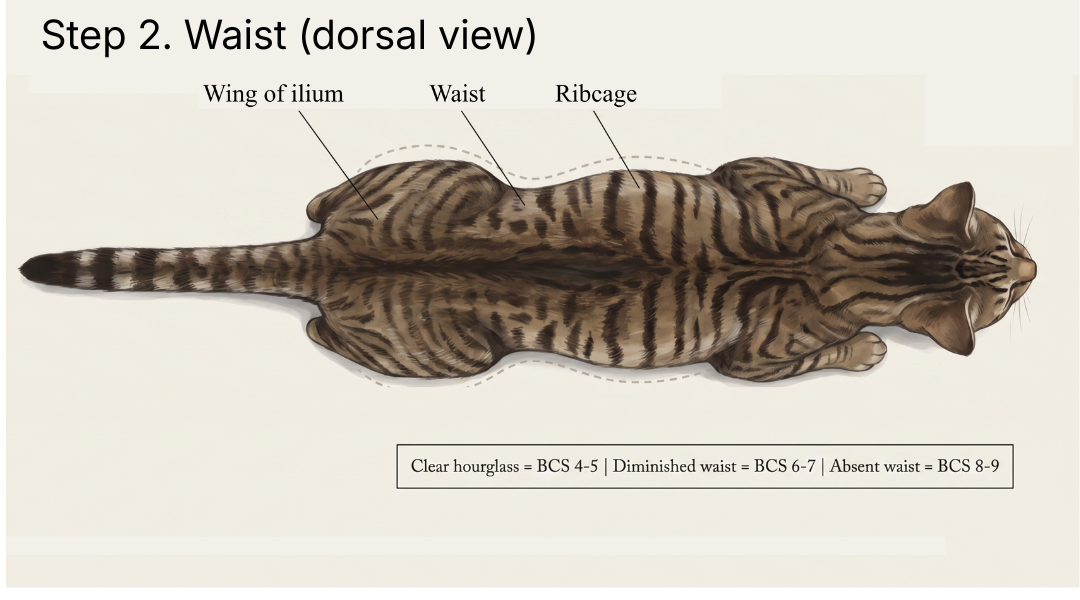
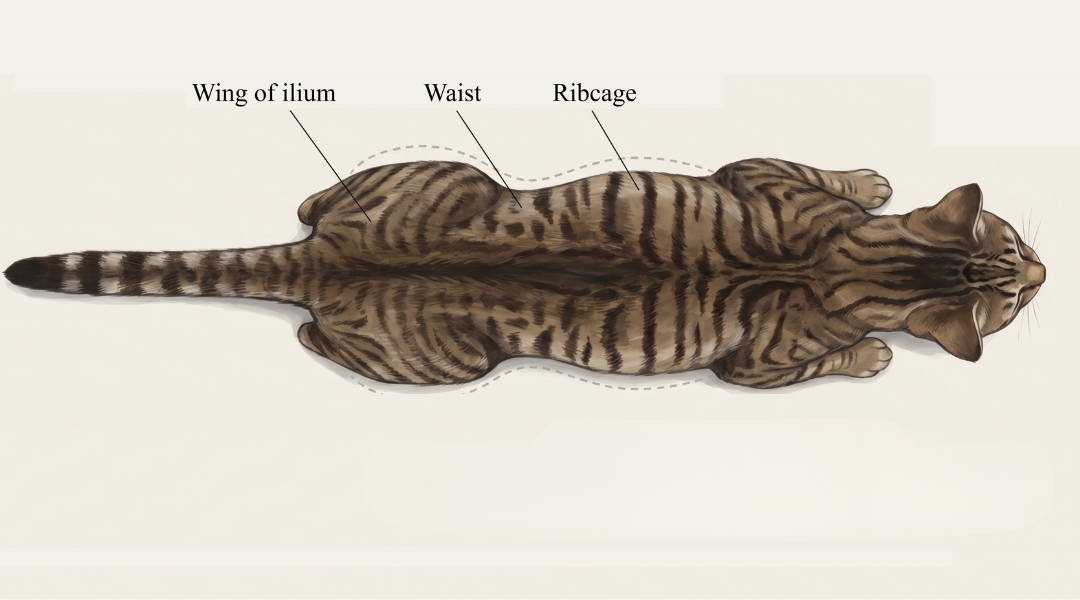
Diagram of a cat's dorsal view showing the wing of ilium, waist, and ribcage, with labels indicating different waist classifications based on BCS.
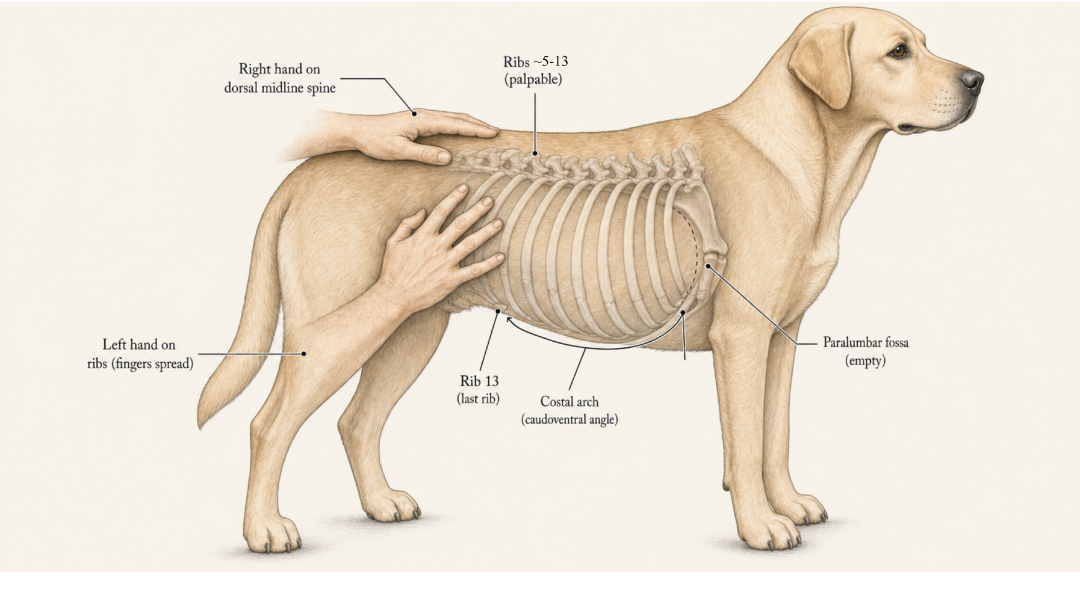
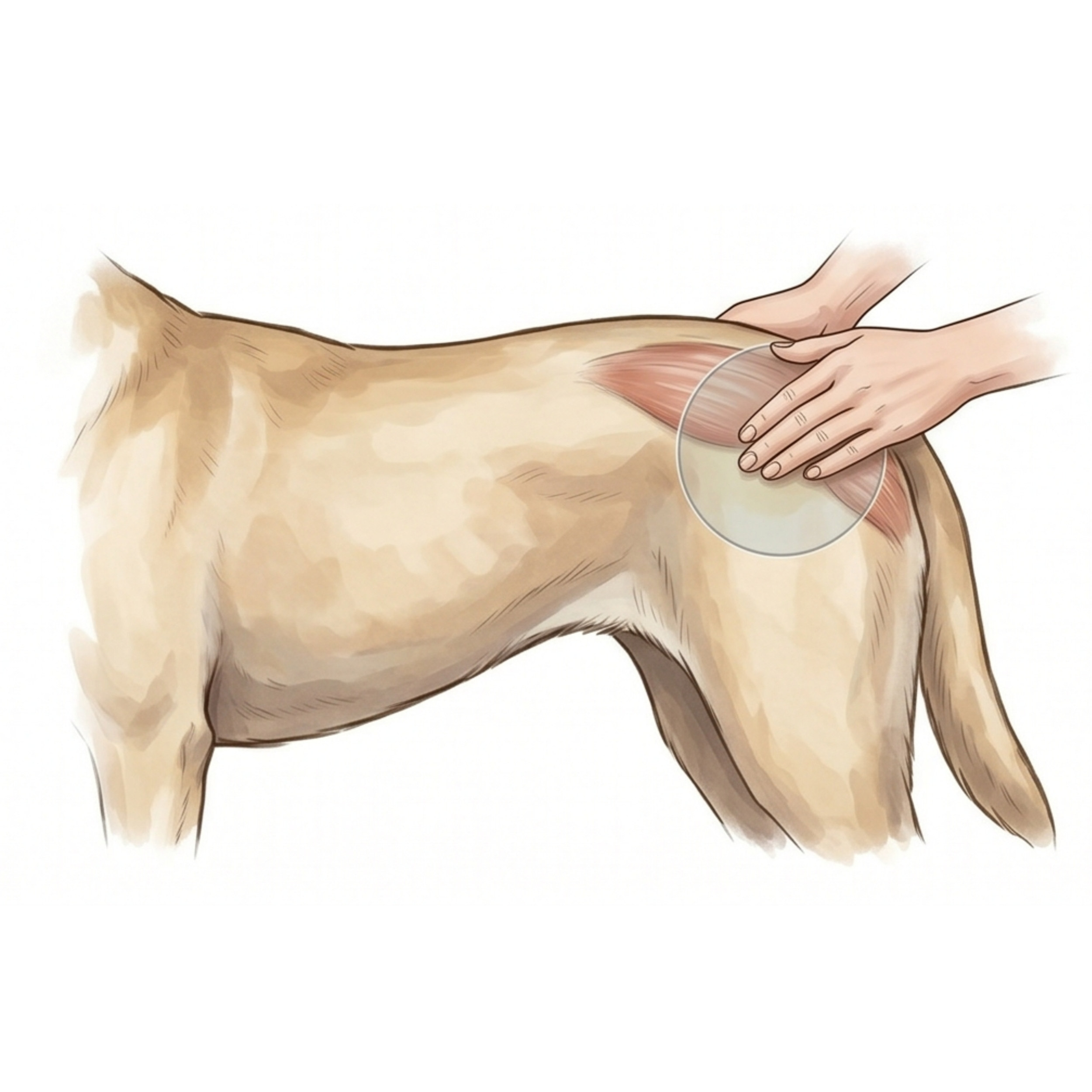
Diagram of a dog with a transparent overlay of its rib cage, showing hand placements on the dog's side indicating palpation points for ribs and dorsal midline, with labels for right hand on dorsal midline spine, left hand on ribs, ribs 5-13, rib 13, costal arch, and parasymbar fossa.
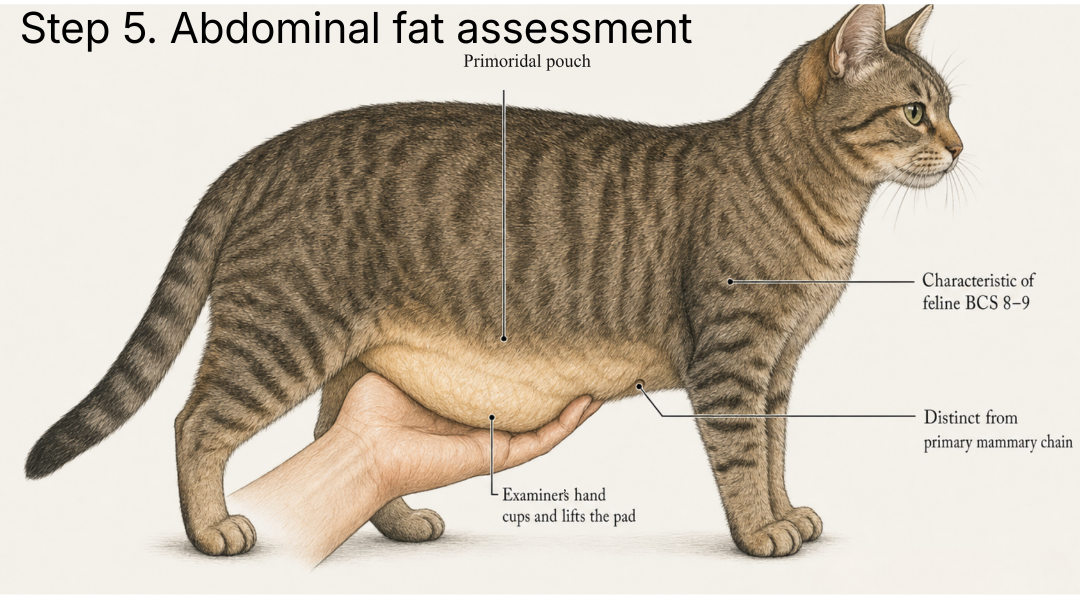
A diagram of a tabby cat showing steps for abdominal fat assessment, with labels pointing to areas on the cat's side for proper evaluation, including the primordial pouch, characteristic feline BCS 8-9, and the primary mammary chain, with an examiner's hand lifting the cat's belly.
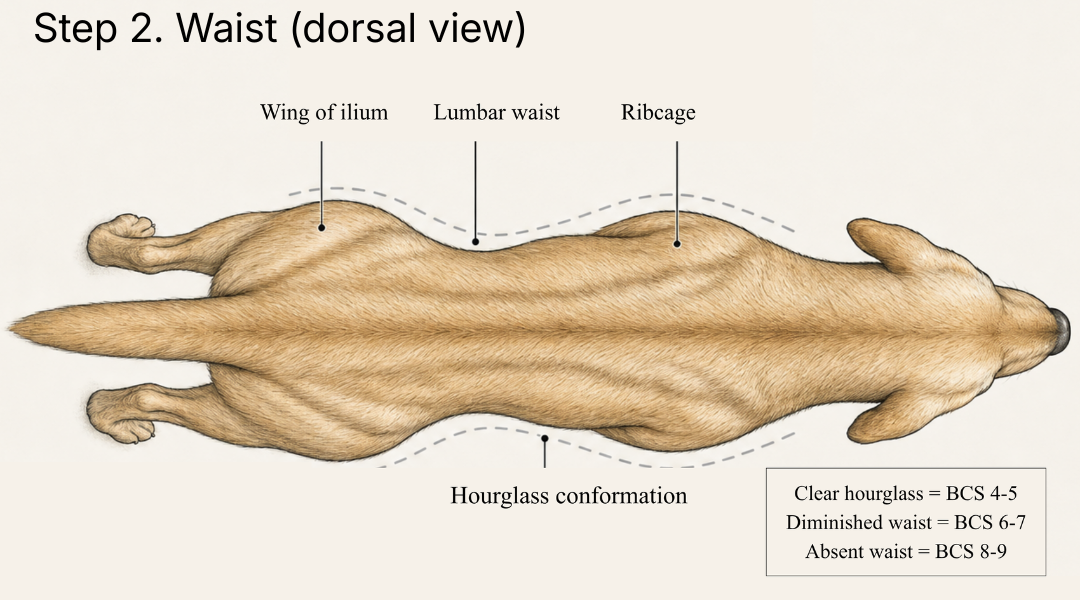
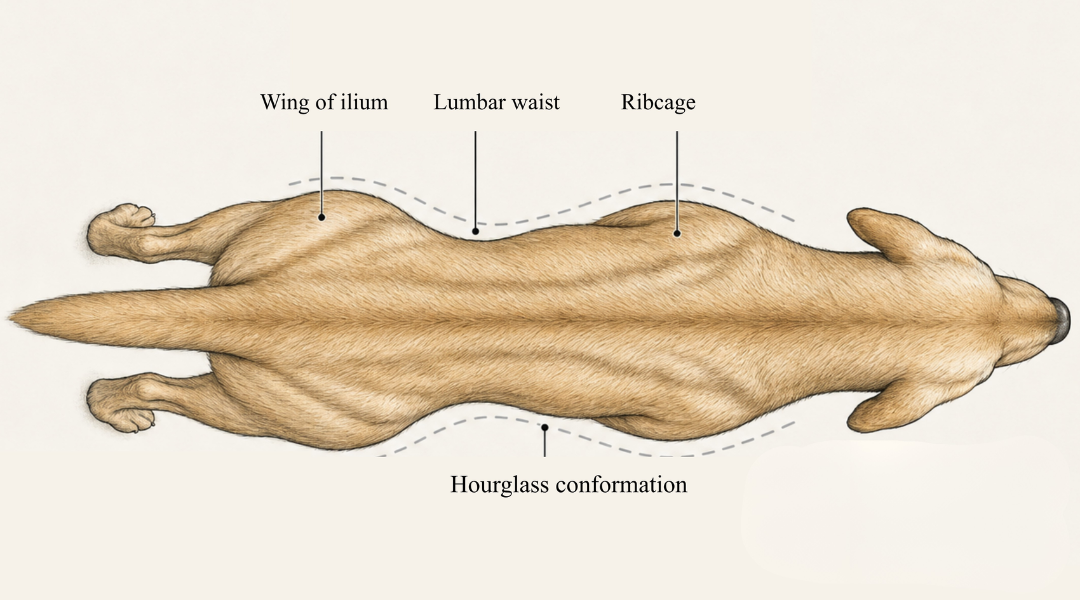
Illustration of a dog seen from above highlighting the waist area with annotations for the wing of ilium, lumbar waist, ribcage, and hourglass conformation, along with guidance for evaluating the hourglass shape based on BCS scores.
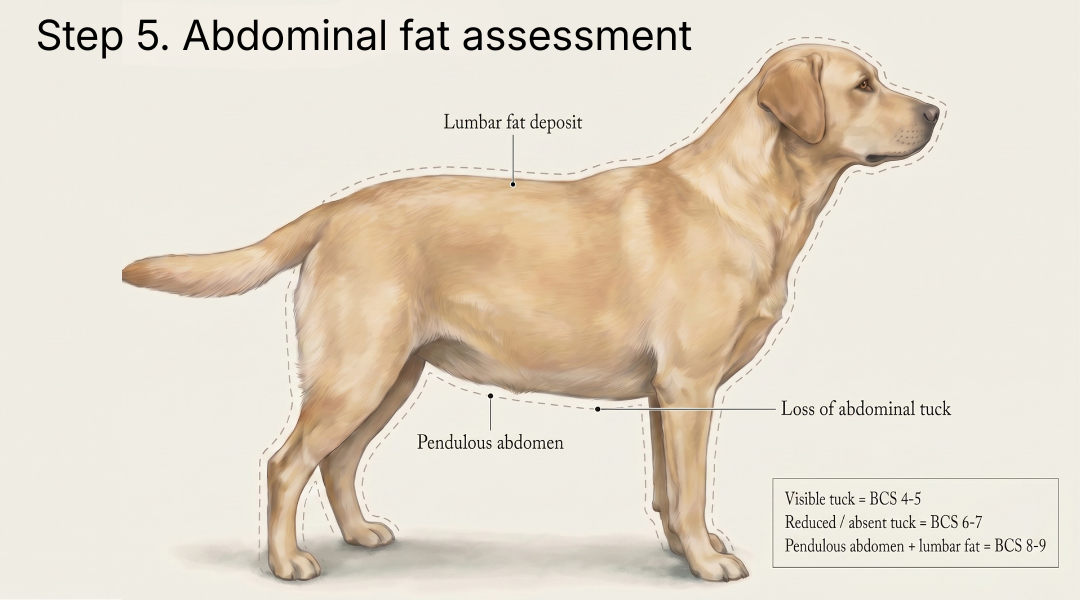
Illustration of a dog with labels indicating areas for abdominal fat assessment, including lumbar fat deposit, loss of abdominal tuck, and pendulous abdomen.
Diagram of a tiger showing body parts including wing of ilium, waist, and ribcage
Illustration of a dog's dorsal view showing anatomical features labeled: Wing of ilium, Lumbar waist, Ribcage, Hourglass conformation.
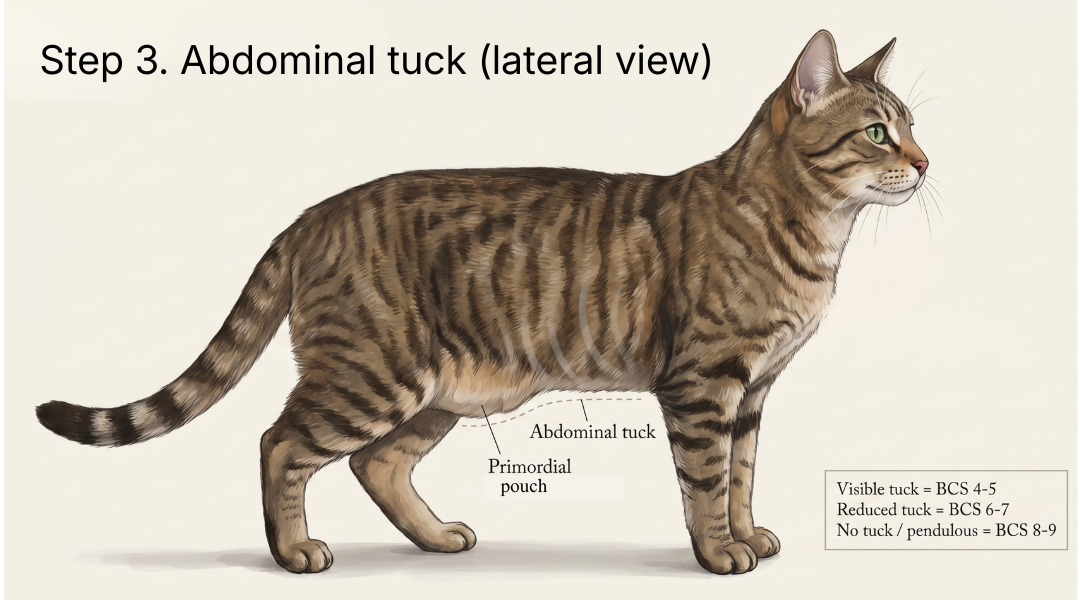
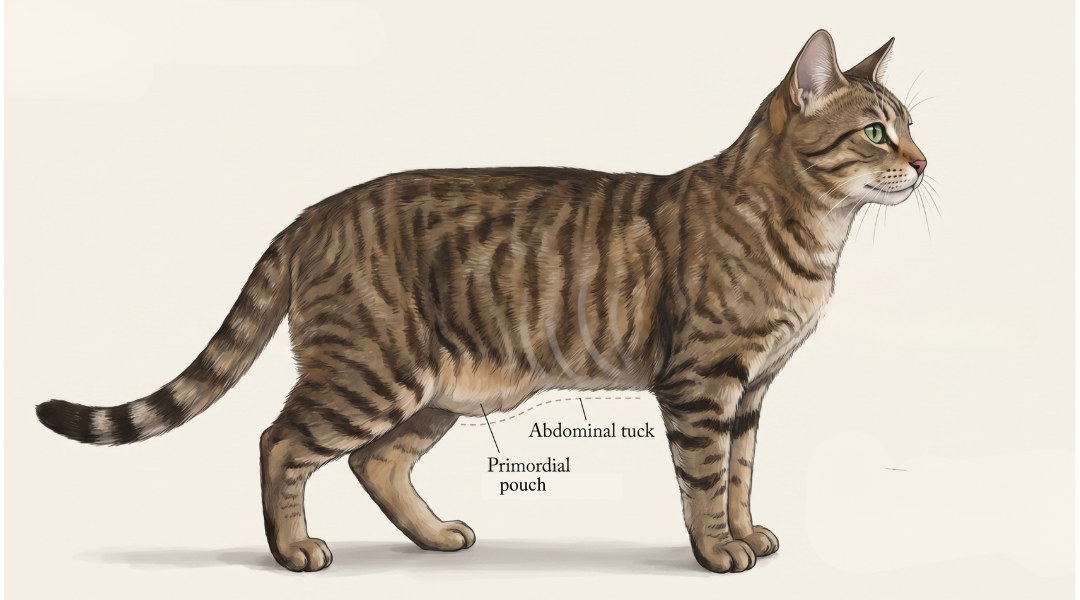
Illustration of a domestic cat demonstrating step 3 of a grooming or medical procedure, showing a lateral view of the cat with labeled parts: abdominal tuck and primordial pouch. The image provides guidance on different types of tucks, with a key explaining visible tuck, reduced tuck, and no tuck.
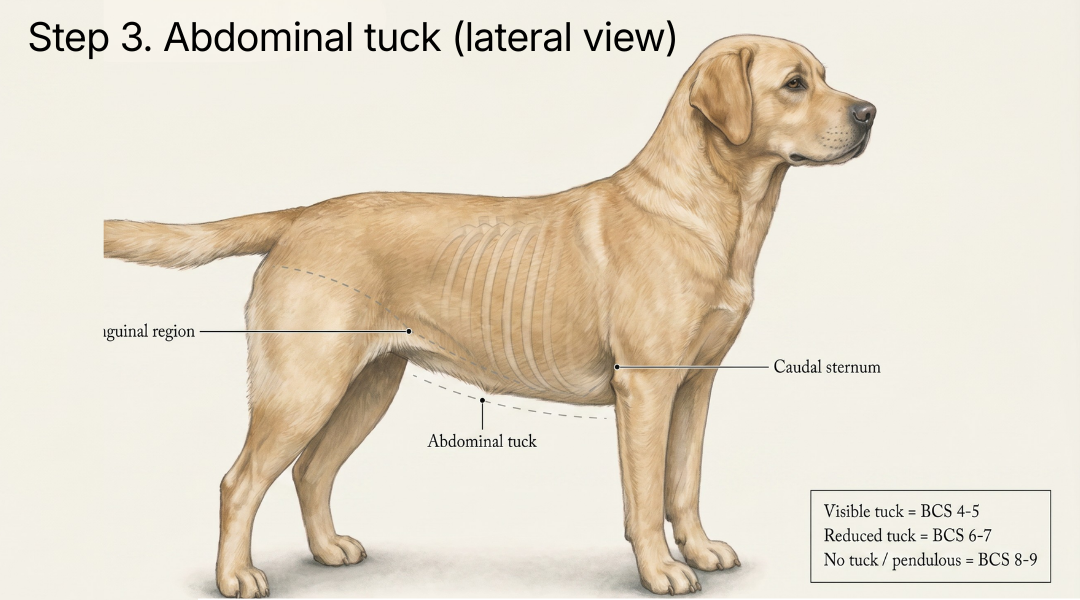
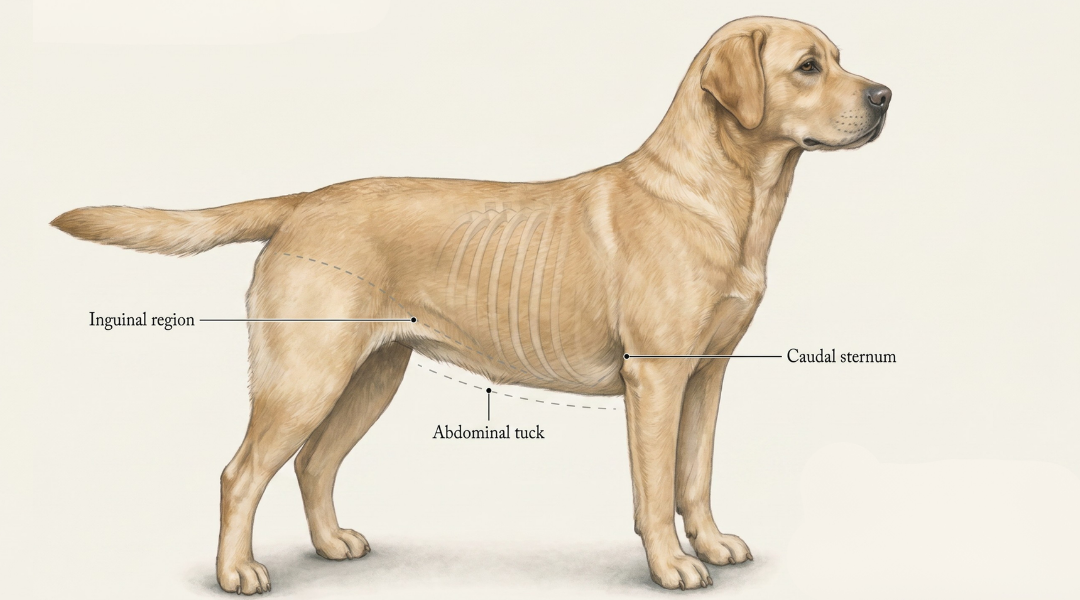
Illustration of a dog showing the lateral view of the abdominal tuck, with labels pointing to the ilioguinal region, abdominal tuck, and caudal sternum. Text explains the different levels of abdominal tuck for breeding status.
Illustration of a cat with labels pointing to its abdominal tuck and primordial pouch.
Illustration of a dog with labeled anatomical features including inguinal region, abdomina tuck, and caudal sternum.
Chart showing the Equine Body Condition Score (BCS) with illustrations of horses at different weight levels from very thin to obese. The chart includes assessment criteria, key palpation sites, and clinical scoring details.
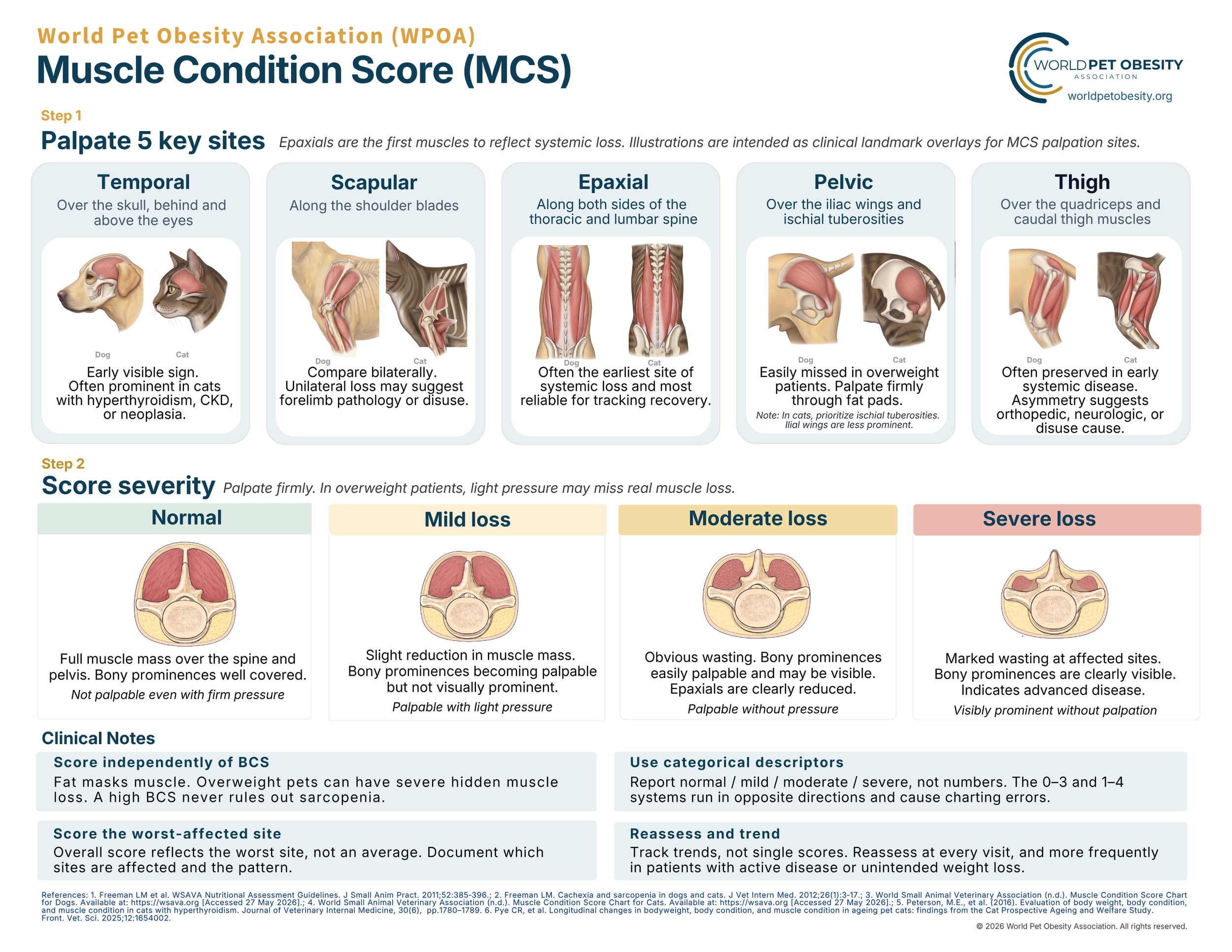
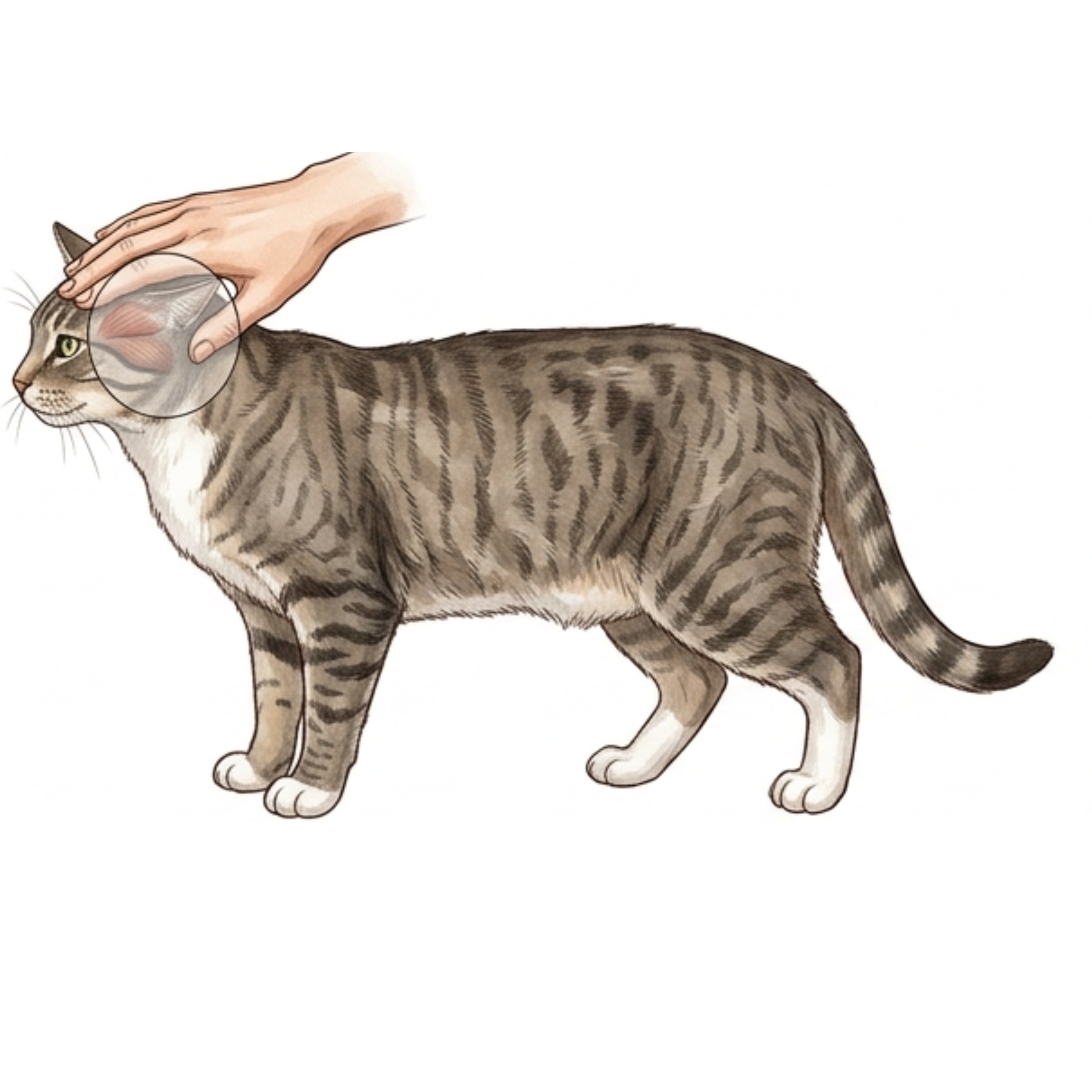
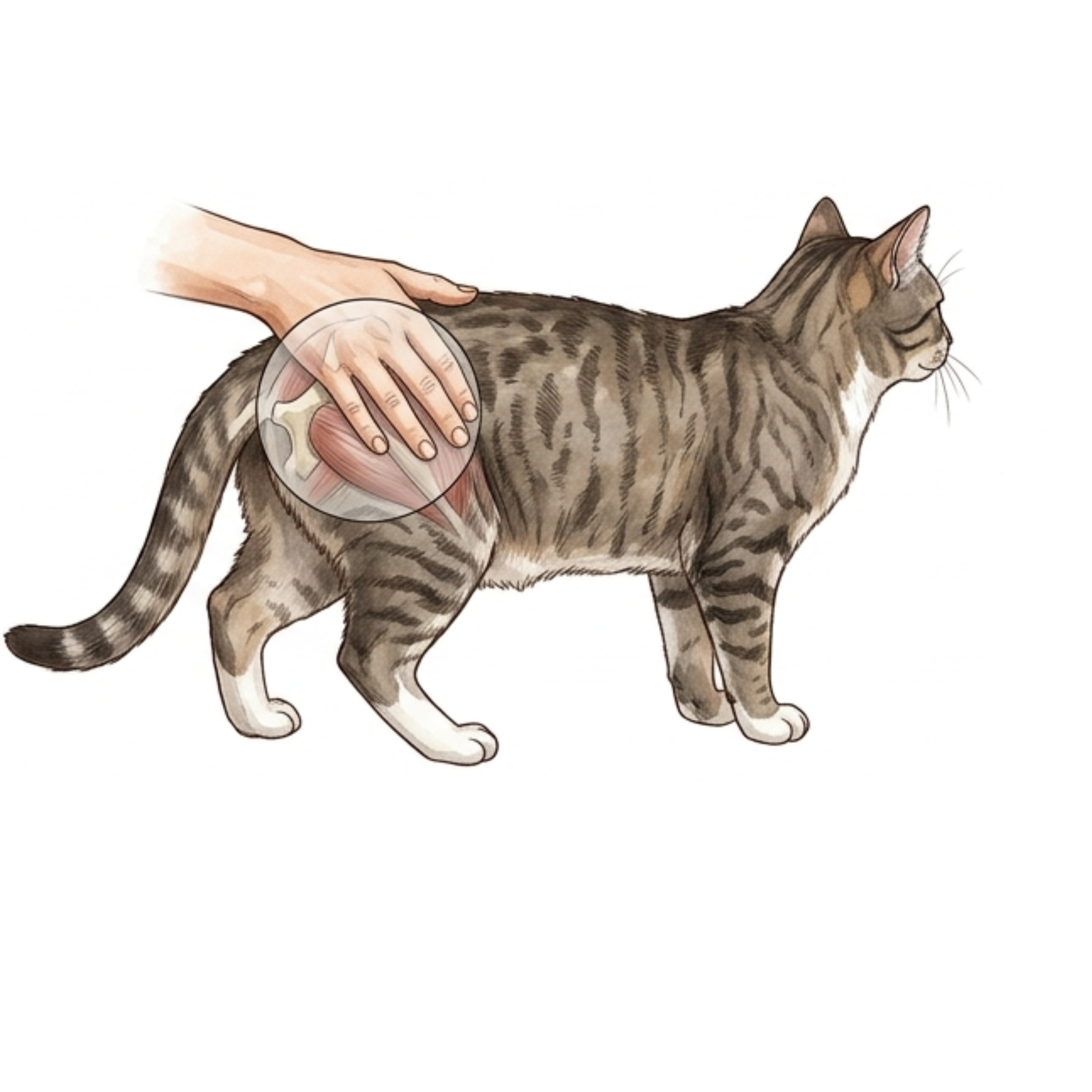
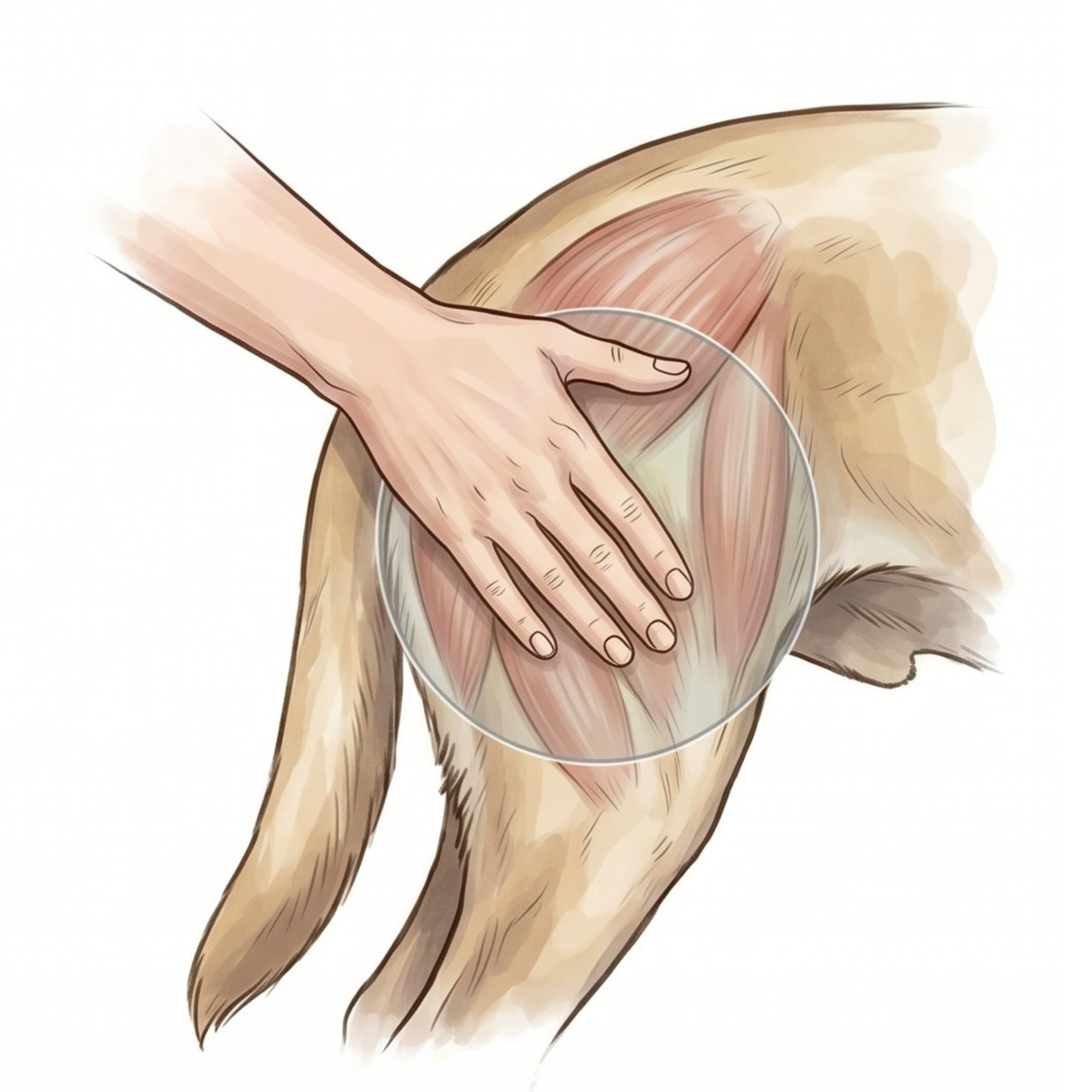
A detailed medical chart from the World Pet Obesity Association explaining how to assess muscle condition in dogs and cats through palpation of five key sites: temporal, scapular, epaxial, pelvic, and thigh, with illustrations and descriptions for each site.

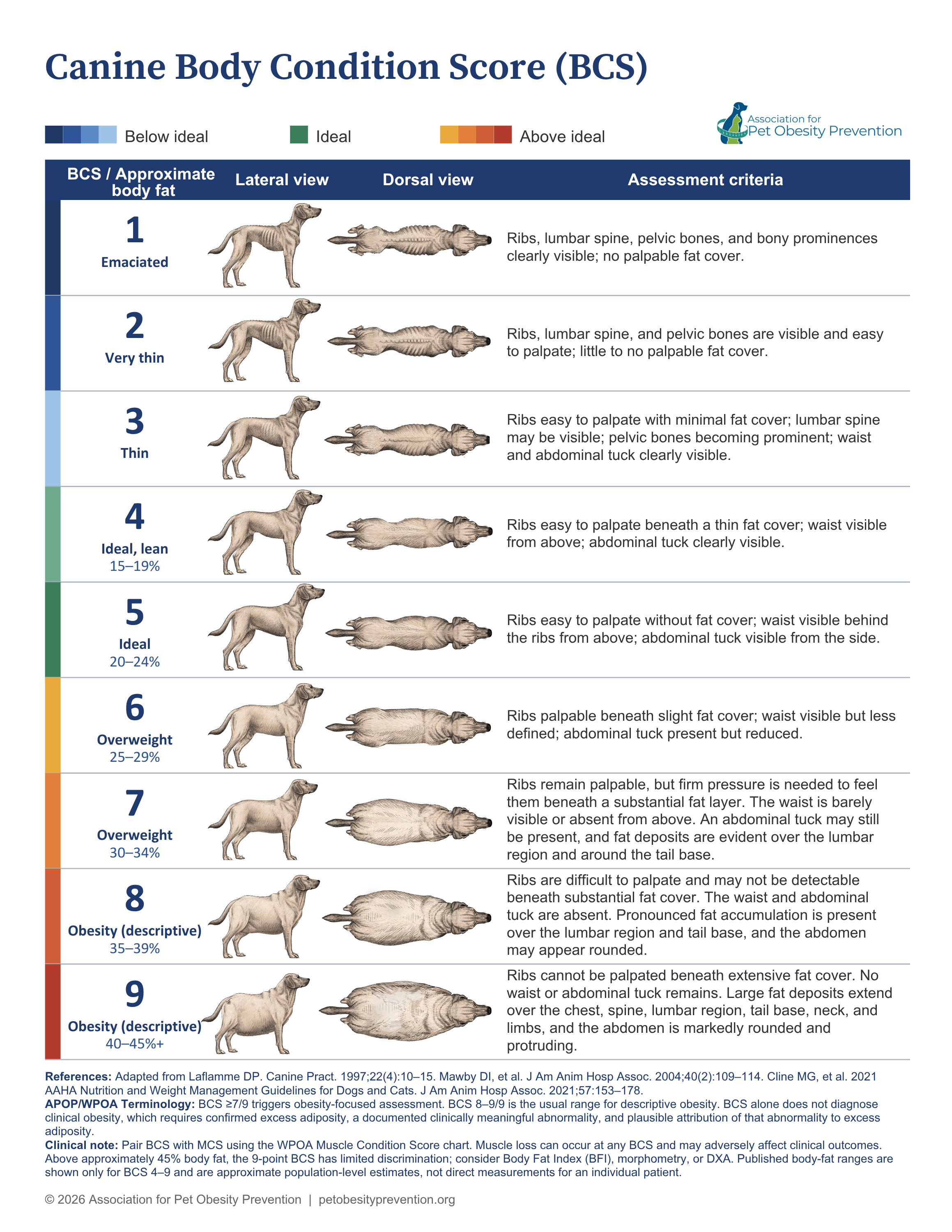
BCS Canine Italian

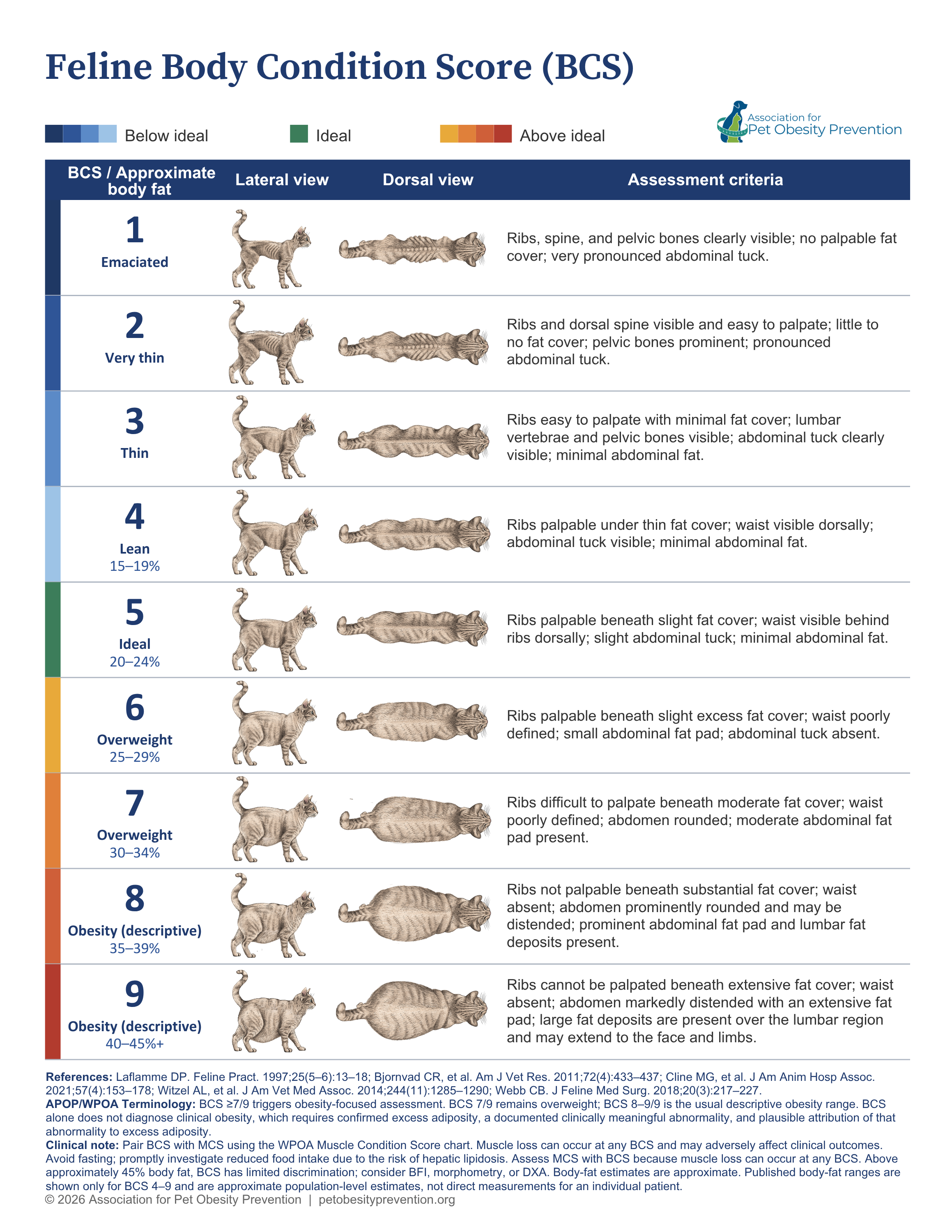
Cat BCS Portuguese

Cat BCS Dutch
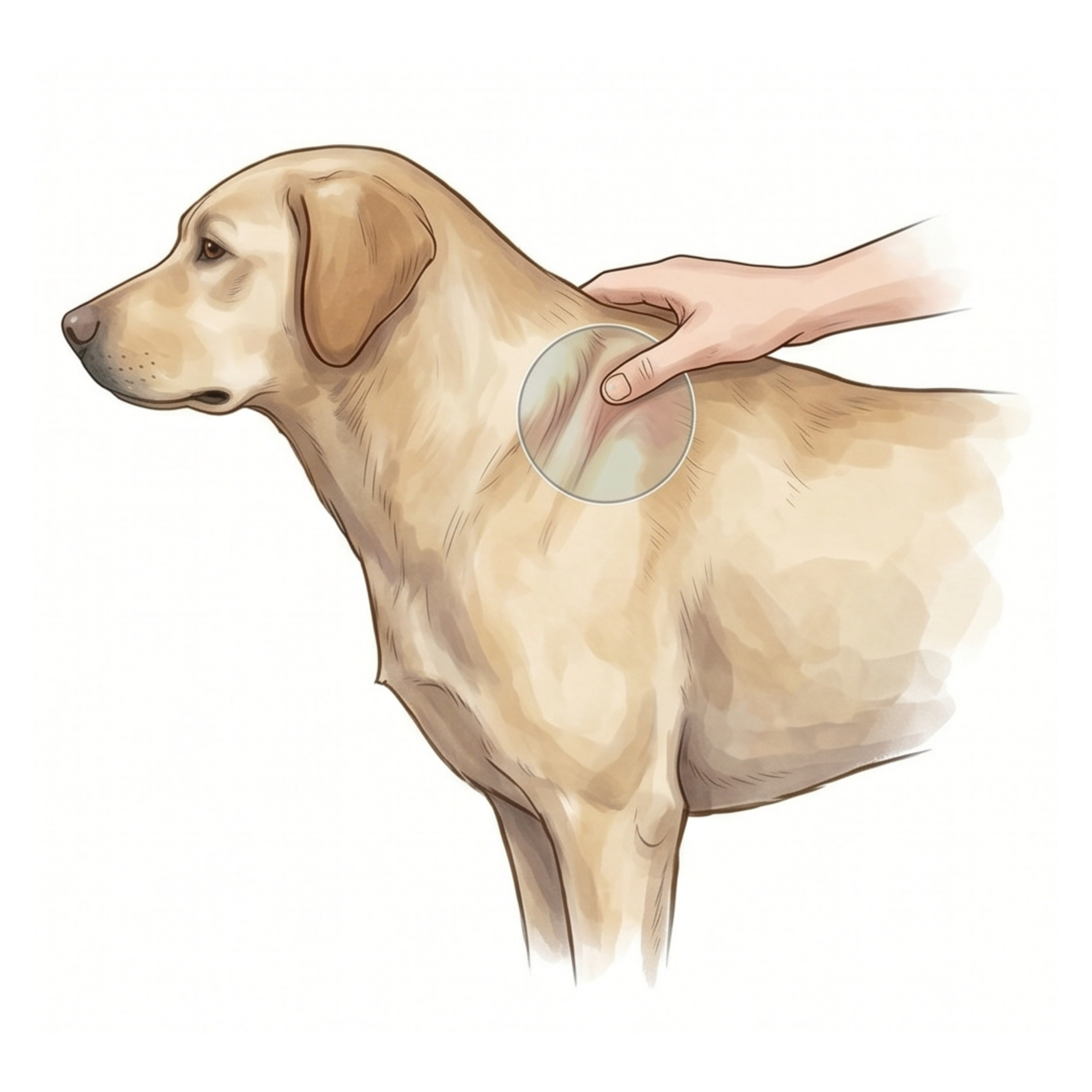
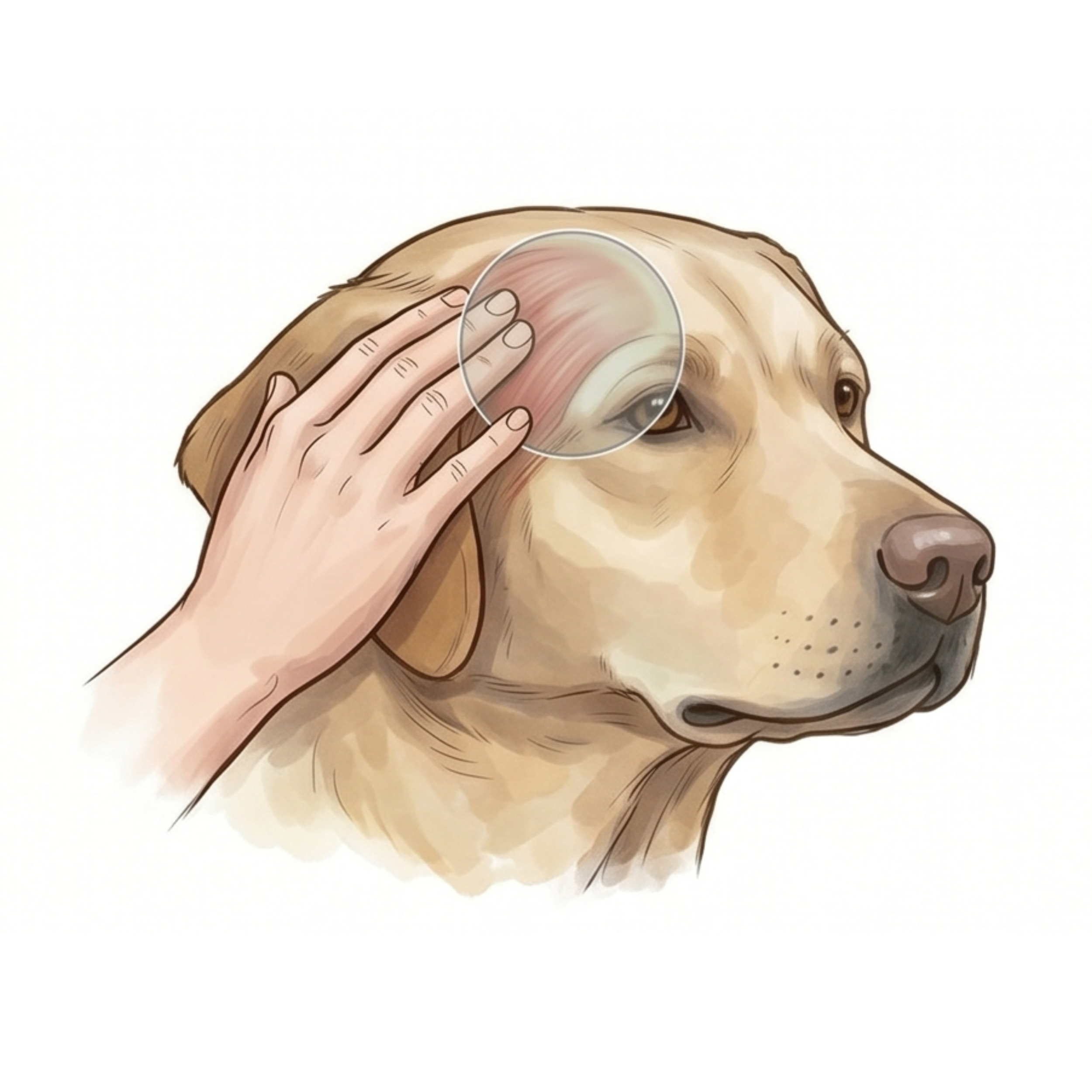
Illustration of a dog with a hand holding a magnifying glass over its eye.
Illustration of a person administering an injection into a dog's side.
Illustration of a tabby cat being held gently by a person's hand, with a diagram showing the placement of a stethoscope's diaphragm on the cat's chest.
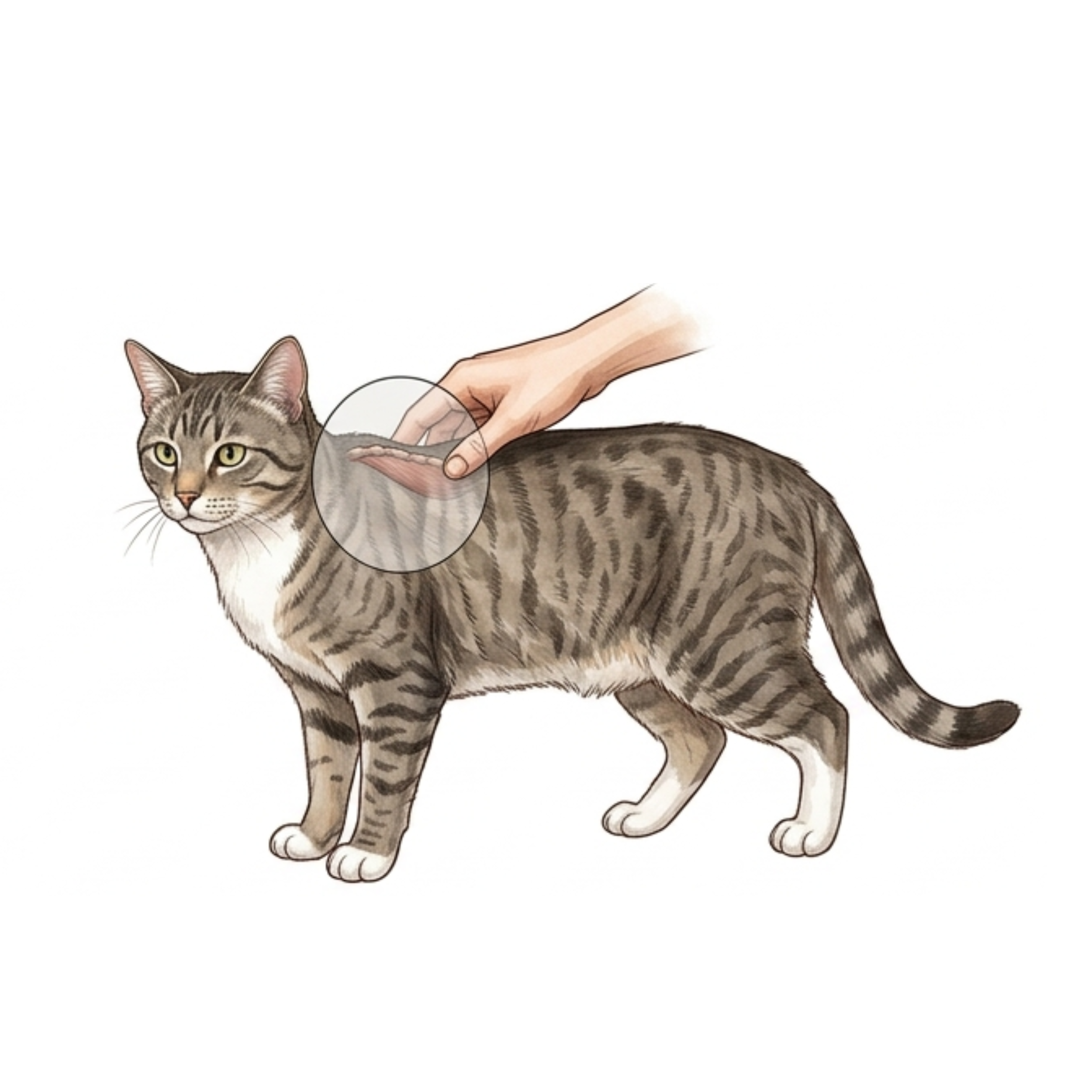
Illustration of a domestic short-haired cat walking with a person brushing its back, showing the cat's striped fur pattern.
Illustration of a person holding a dog's neck as if checking or examining it.
Illustration of a person sitting on a stool, cross-legged, with their back facing the viewer.
Illustration of a person petting a tabby cat, showing a hand with the petting motion and a focused cat with green eyes.
Illustration of a person’s hand petting a gray tabby cat.
Illustration of a person with light skin and painted nails gently touching a brown dog with floppy ears, who is lying on the floor.
An illustration of a tabby cat being examined with a stethoscope on its side.
A man with a bald head, gray beard, dressed in a navy blazer and light blue shirt, speaking passionately and gesturing with his hands while holding a microphone.