
Clinical Chart Library
Multilingual Body Condition Score and Muscle Condition Score Charts
Download English-only simplified BCS guides, plus detailed BCS and MCS charts available in multiple languages for veterinary teams, educators, and pet health organizations.
English chart library
English-language downloads
Choose an English-only simplified BCS guide for a dog, cat, rabbit, or horse, or a detailed dog, cat, or horse clinical chart. Simplified guides use shorter, plain-language descriptions and are not currently translated. Translated detailed dog and cat BCS charts, plus dog-and-cat MCS where available, are listed in the language library. Select any preview or “View full chart” to open the high-resolution PNG.
Simplified BCS charts
Designed for pet owners, caregivers, classrooms, and general education. These simplified charts are available in English only and are not currently translated.
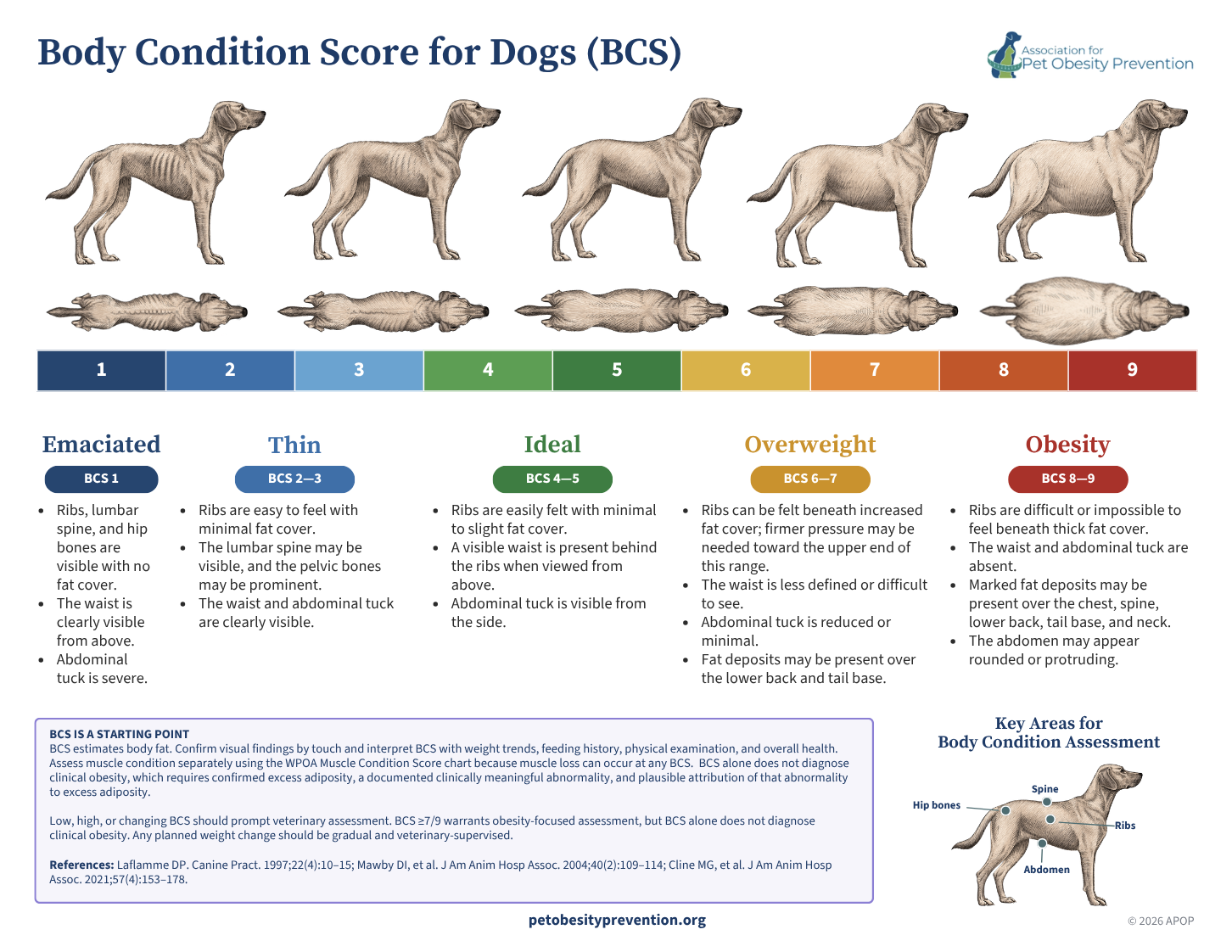
BCS · Dog
Simplified · English onlyDog Body Condition Score
Plain-language visual guide for pet owners, families, classrooms, and general education.
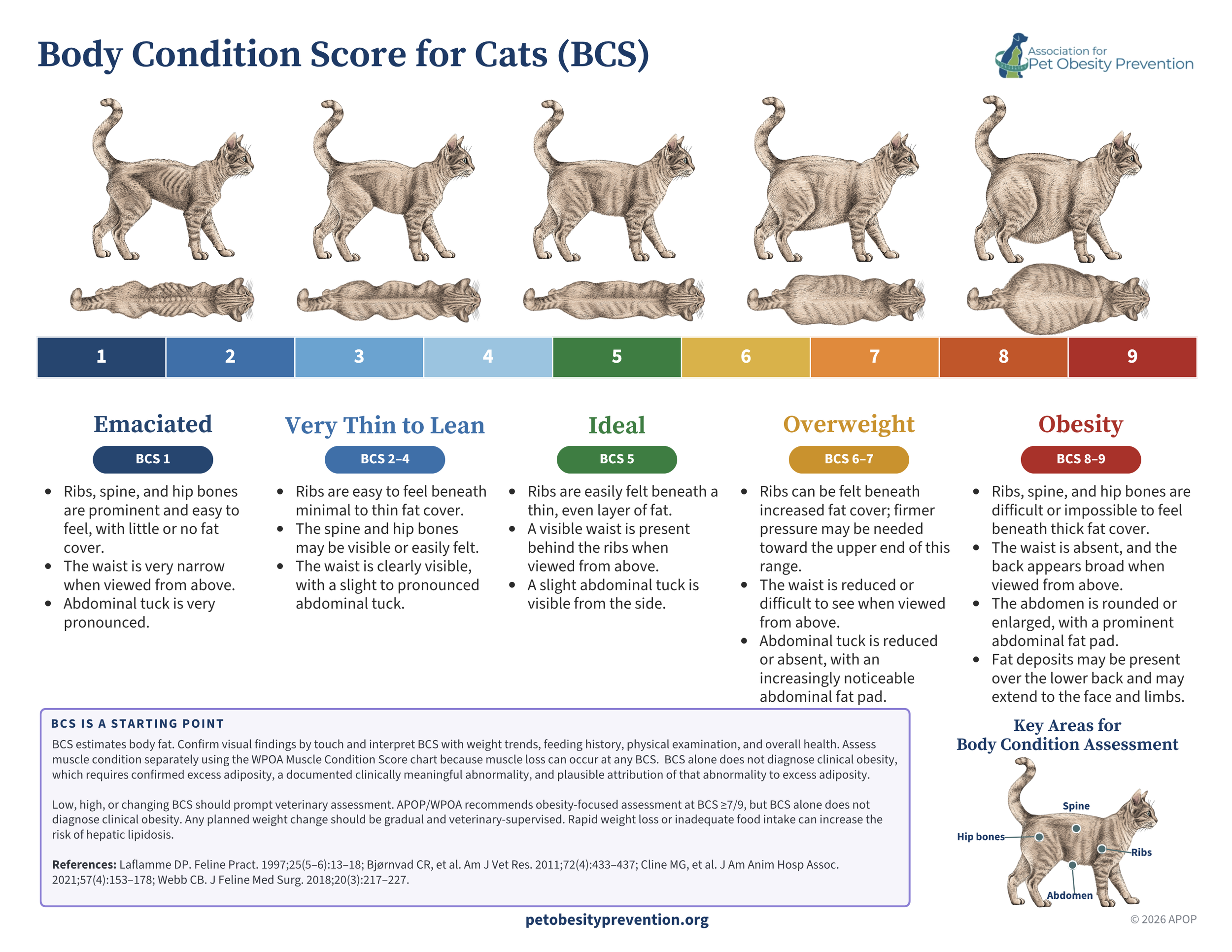
BCS · Cat
Simplified · English onlyCat Body Condition Score
Plain-language visual guide for pet owners, families, classrooms, and general education.
BCS · Rabbit
Simplified · English onlyRabbit Body Condition Score
Plain-language visual guide for rabbit owners, caregivers, classrooms, and general education.

BCS · Horse
Simplified · English onlyHorse Body Condition Score
Plain-language visual guide for horse owners, caregivers, classrooms, and general education.

Detailed Dog, Cat & Horse BCS Charts
Detailed dog, cat, and horse charts with complete assessment criteria for veterinary teams, educators, printing, and medical documentation.
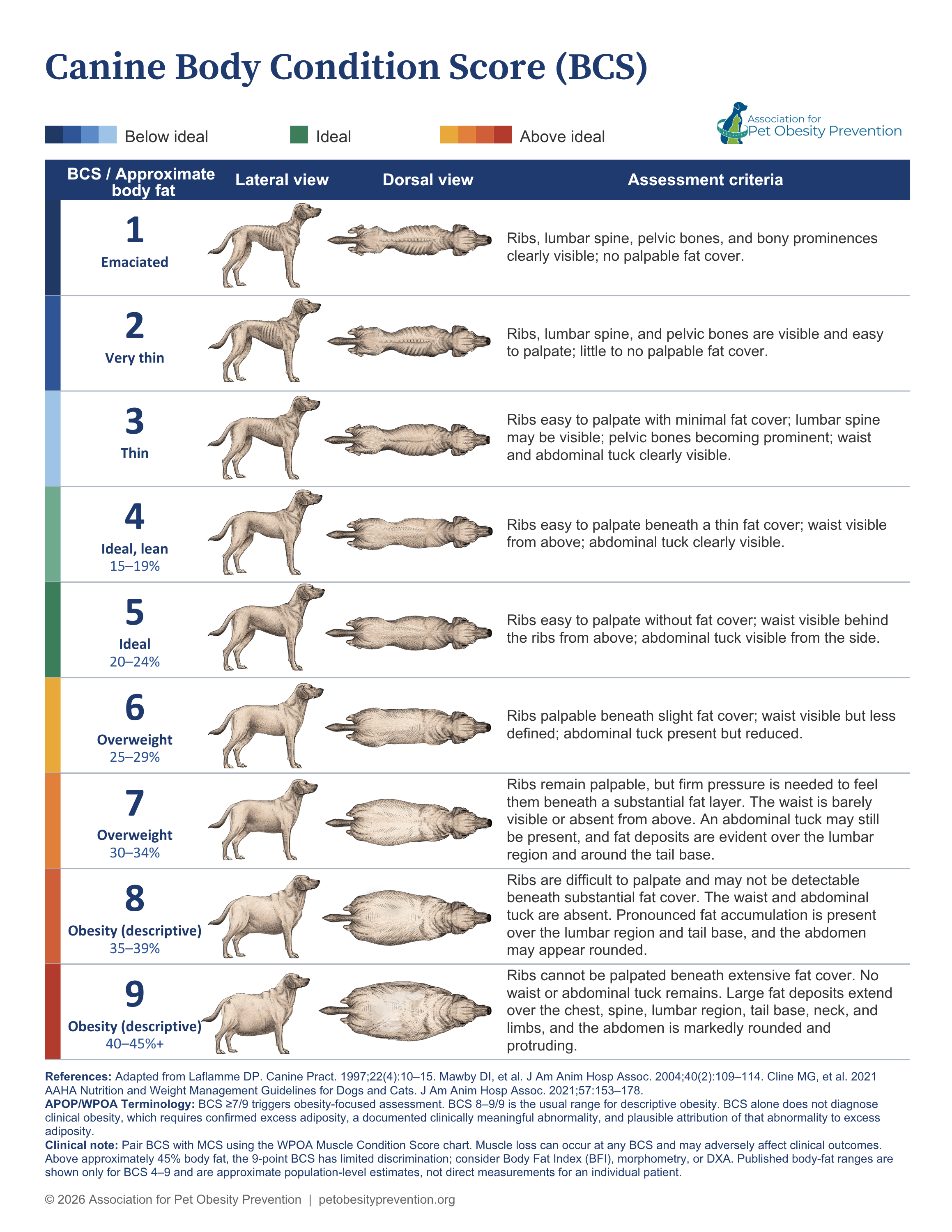
BCS · Dog
DetailedDog Body Condition Score
Detailed score-by-score chart for clinical assessment, teaching, printing, and documentation.
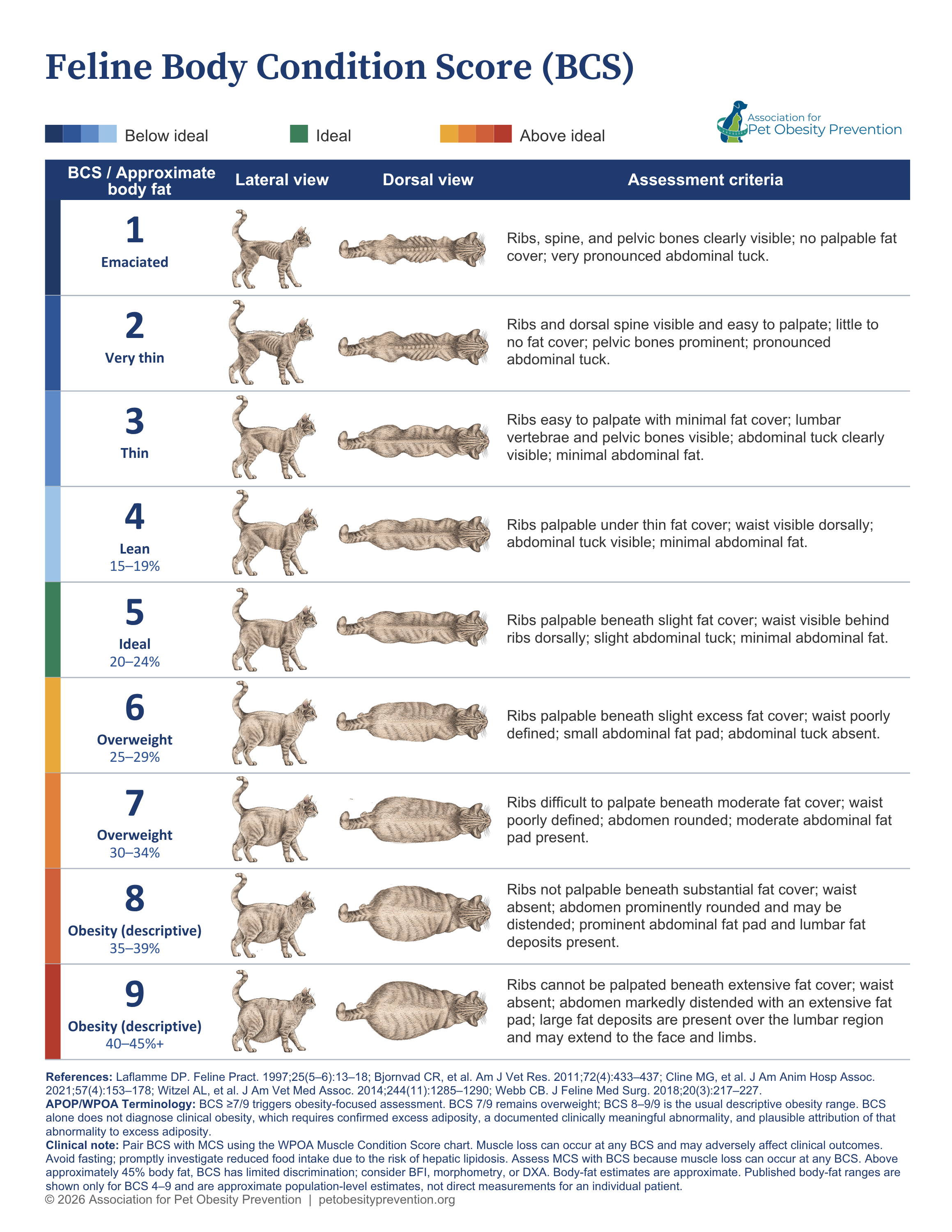
BCS · Cat
DetailedCat Body Condition Score
Detailed score-by-score chart for clinical assessment, teaching, printing, and documentation.
BCS · Horse
DetailedHorse Body Condition Score
Detailed equine chart for clinical assessment, teaching, printing, and documentation.

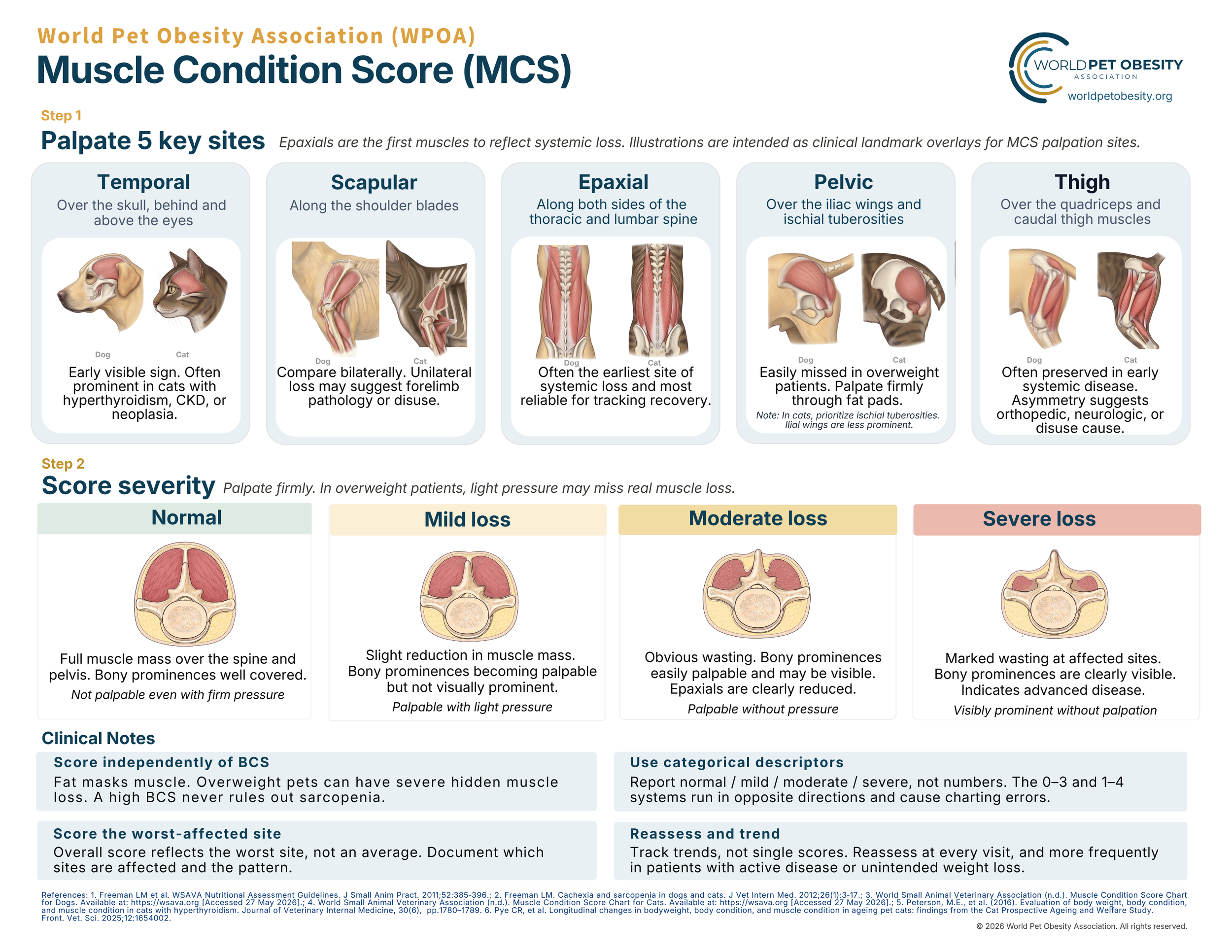
Dog & Cat Muscle Condition Score
Use MCS alongside body weight and BCS to document skeletal muscle independently of adiposity in dogs and cats.
MCS · Dog & Cat
Clinical guideDog & Cat Muscle Condition Score
Combined dog and cat guide for evaluating skeletal muscle separately from body fat.
Language Library
Detailed BCS and MCS charts by language
The translations below apply to the detailed BCS charts and, where available, the combined dog-and-cat MCS chart. Simplified visual guides are currently available in English only. English is listed first, followed by languages in alphabetical order.
Translation notes
Format availability: The simplified dog, cat, rabbit, and horse BCS guides are English only and are not included in the translated library.
WPOA and APOP translate the detailed Body Condition Score and Muscle Condition Score tools to preserve clinical meaning, reflect regional veterinary terminology, and support patient-first communication. Translations are not intended to be word-for-word equivalents of the English source text.
Veterinary terminology varies by country, region, and professional convention. We welcome feedback from native-speaking veterinary professionals when wording could be clearer, more clinically accurate, or better aligned with terminology used in their region.
English
English
Simplified BCS charts · English only
Detailed BCS charts · Dog, Cat & Horse
Dog & Cat Muscle Condition Score
Arabic
العربية
Coming soon
Chinese Simplified
简体中文
Available downloads
Dutch
Nederlands
Available downloads
Coming soon
French
Français
Available downloads
German
Deutsch
Available downloads
Hindi
हिन्दी
Coming soon
Indonesian
Bahasa Indonesia
Coming soon
Italian
Italiano
Available downloads
Japanese
日本語
Coming soon
Korean
한국어
Coming soon
Polish
Polski
Coming soon
Portuguese (Brazil)
Português (Brasil)
Available downloads
Portuguese (Portugal)
Português (Portugal)
Available downloads
Russian
Русский
Coming soon
Spanish
Español
Available downloads
Thai
ไทย
Coming soon
Turkish
Türkçe
Coming soon
Vietnamese
Tiếng Việt
Coming soon
Muscle Condition Score translations are provided as one combined dog and cat chart. Simplified visual guides are English only. Additional detailed-chart and MCS languages are in development.
About These Tools
About WPOA Body Condition Score and Muscle Condition Score charts
Clinical scoring tools for veterinary professionals, educators, researchers, and pet health organizations.
Body condition scoring: 9-point scale
BCS estimates adiposity through visual inspection and palpation. It supports comprehensive patient assessment, including disease monitoring, prognosis, surgical and anesthetic risk stratification, weight-management planning, and clinical obesity screening. WPOA/APOP uses a 9-point scale based on the validated Laflamme BCS system.[1,2]
Why 9 points, not 5? Each integer on the 9-point scale represents approximately half a unit on a 5-point scale, allowing veterinary teams to document smaller changes in adiposity over time. The 9-point BCS system has been validated against body fat percentage estimates, including DEXA-supported studies in dogs and cats.[1,2,3,4]
Body condition has also been associated with survival or lifespan outcomes in both dogs and cats.[5,6,7]
Species-specific BCS: why feline 4/9 is different
Dog and cat BCS charts are species-specific. The same BCS number does not always carry identical wording or clinical interpretation across species, so the full species-specific description should be used rather than the number alone.
The feline chart identifies BCS 5/9 as the ideal score. This differs from the canine chart, where BCS 4–5/9 is commonly classified as the healthy or ideal range. Bjornvad et al. found that indoor-confined neutered domestic shorthair cats scoring BCS 5/9 had a mean body fat percentage of 32% by DEXA in that study population.[2,4]
Feline BCS 4/9 should be interpreted in context. In an ageing or geriatric cat, BCS 4/9 or a declining BCS trend may reflect disease-associated weight loss rather than healthy leanness. A downward trend warrants clinical investigation even if the score does not appear severely low.[8,9,10,11]
BCS 7–9: when to screen for clinical obesity
BCS 7–9/9 should be treated as a clinical obesity screening zone. Patients scoring 7/9 or higher warrant a more complete assessment for excess adiposity, muscle condition, nutritional history, clinical signs, functional changes, laboratory abnormalities, and adiposity-associated disease. A high BCS identifies excess adiposity risk, but it does not diagnose clinical obesity by itself.
Clinical obesity requires patient-specific evidence using the Three A’s framework: Adiposity, Abnormality, and Attribution. The score should trigger clinical evaluation, not replace it.[12]
For weight-management planning, the 2014 AAHA Weight Management Guidelines remain a focused companion reference, while the 2021 AAHA Nutrition and Weight Management Guidelines provide broader nutrition-assessment guidance.[13,14]
Learn more in the Clinical Obesity framework.
Muscle condition scoring: why BCS and MCS both matter
MCS evaluates skeletal muscle mass independently of body fat through visual examination and palpation. It supports sarcopenia monitoring, cachexia detection, prognosis, quality-of-life evaluation, and weight-management planning.
BCS and MCS answer different clinical questions. BCS estimates adiposity. MCS evaluates skeletal muscle. A dog or cat can have excess body fat and clinically significant muscle loss at the same time, so BCS alone does not provide a complete body composition assessment.[14,15,16,17]
WPOA/APOP recommends recording body weight, BCS, and MCS together during patient assessment.[15]
MCS has been correlated with ultrasonographic measurements of epaxial musculature in dogs and cats, supporting its use as a practical clinical screening tool for muscle loss.[18,19]
How to score MCS: five palpation sites
Use the WPOA/APOP Muscle Condition Score chart to evaluate five regions: temporal muscles, scapulae, epaxial muscles, pelvic region, and hindlimb / caudal thigh.[15]
The hindlimb musculature is innervated and loaded differently from axial muscles and does not necessarily atrophy at the same rate or in response to the same processes. Asymmetric hindlimb loss may indicate an orthopedic, neurologic, or disuse cause rather than systemic muscle wasting.[11,15,16]
How to score: palpate each region firmly through any fat cover, compare bilaterally, identify the site with the greatest muscle loss, and assign the overall MCS from that site. Do not average across sites.
See the complete Muscle Condition Score guide.
Selected references
- Laflamme, D. P. (1997). Development and validation of a body condition score system for dogs. Canine Practice, 22(4), 10–15.
- Laflamme, D. P. (1997). Development and validation of a body condition score system for cats: A clinical tool. Feline Practice, 25(5–6), 13–18.
- Mawby, D. I., Bartges, J. W., d'Avignon, A., Laflamme, D. P., Moyers, T. D., & Cottrell, T. (2004). Comparison of various methods for estimating body fat in dogs. Journal of the American Animal Hospital Association, 40(2), 109–114. https://doi.org/10.5326/0400109
- Bjornvad, C. R., Nielsen, D. H., Armstrong, P. J., McEvoy, F., Hoelmkjaer, K. M., Jensen, K. S., Pedersen, G. F., & Kristensen, A. T. (2011). Evaluation of a nine-point body condition scoring system in physically inactive pet cats. American Journal of Veterinary Research, 72(4), 433–437. https://doi.org/10.2460/ajvr.72.4.433
- Kealy, R. D., Lawler, D. F., Ballam, J. M., Mantz, S. L., Biery, D. N., Greeley, E. H., Lust, G., Segre, M., Smith, G. K., & Stowe, H. D. (2002). Effects of diet restriction on life span and age-related changes in dogs. Journal of the American Veterinary Medical Association, 220(9), 1315–1320. https://doi.org/10.2460/javma.2002.220.1315
- Salt, C., Morris, P. J., Wilson, D., Lund, E. M., & German, A. J. (2019). Association between life span and body condition in neutered client-owned dogs. Journal of Veterinary Internal Medicine, 33(1), 89–99. https://doi.org/10.1111/jvim.15367
- Teng, K. T., McGreevy, P. D., Toribio, J. A. L. M. L., Raubenheimer, D., Kendall, K., & Dhand, N. K. (2018). Strong associations of nine-point body condition scoring with survival and lifespan in cats. Journal of Feline Medicine and Surgery, 20(12), 1110–1118. https://doi.org/10.1177/1098612X17752198
- Baez, J. L., Michel, K. E., Sorenmo, K., & Shofer, F. S. (2007). A prospective investigation of the prevalence and prognostic significance of weight loss and changes in body condition in feline cancer patients. Journal of Feline Medicine and Surgery, 9(5), 411–417. https://doi.org/10.1016/j.jfms.2007.02.005
- Freeman, L. M., Lachaud, M. P., Matthews, S., Rhodes, L., Zollers, B., & Rand, J. (2016). Evaluation of weight loss over time in cats with chronic kidney disease. Journal of Veterinary Internal Medicine, 30(5), 1661–1666. https://doi.org/10.1111/jvim.14561
- Pittari, J., Rodan, I., Beekman, G., Gunn-Moore, D., Polzin, D., Taboada, J., Tuzio, H., & Zoran, D. (2009). Senior care guidelines. Journal of Feline Medicine and Surgery, 11(9), 763–778. https://doi.org/10.1016/j.jfms.2009.07.011
- Pye, C. R., Dowgray, N. J., Eyre, K., Pinchbeck, G., Biourge, V., Moniot, D., Comerford, E., & German, A. J. (2025). Longitudinal changes in bodyweight, body condition, and muscle condition in ageing pet cats. Frontiers in Veterinary Science, 12, 1654002. https://doi.org/10.3389/fvets.2025.1654002
- World Pet Obesity Association / Association for Pet Obesity Prevention. Clinical obesity framework. https://worldpetobesity.org/clinicalobesity
- Brooks, D., Churchill, J., Fein, K., Linder, D., Michel, K. E., Tudor, K., Ward, E., & Witzel, A. (2014). 2014 AAHA weight management guidelines for dogs and cats. Journal of the American Animal Hospital Association, 50(1), 1–11. https://doi.org/10.5326/JAAHA-MS-6331
- Cline, M. G., Burns, K. M., Coe, J. B., Downing, R., Durzi, T., Murphy, M., & Parker, V. (2021). 2021 AAHA nutrition and weight management guidelines for dogs and cats. Journal of the American Animal Hospital Association, 57(4), 153–178. https://doi.org/10.5326/JAAHA-MS-7232
- World Pet Obesity Association / Association for Pet Obesity Prevention. Muscle condition score. https://worldpetobesity.org/mcs
- Freeman, L. M. (2012). Cachexia and sarcopenia: Emerging syndromes of importance in dogs and cats. Journal of Veterinary Internal Medicine, 26(1), 3–17. https://doi.org/10.1111/j.1939-1676.2011.00838.x
- Freeman, L. M., Becvarova, I., Cave, N., MacKay, C., Nguyen, P., Rama, B., Takashima, G., Tiffin, R., Tsjimoto, H., & van Beukelen, P. (2011). WSAVA nutritional assessment guidelines. Journal of Small Animal Practice, 52(7), 385–396. https://doi.org/10.1111/j.1748-5827.2011.01079.x
- Freeman, L. M., Michel, K. E., Zanghi, B. M., Vester Boler, B. M., & Fages, J. (2019). Evaluation of the use of muscle condition score and ultrasonographic measurements for assessment of muscle mass in dogs. American Journal of Veterinary Research, 80(6), 595–600. https://doi.org/10.2460/ajvr.80.6.595
- Freeman, L. M., Michel, K. E., Zanghi, B. M., Vester Boler, B. M., & Fages, J. (2020). Usefulness of muscle condition score and ultrasonographic measurements for assessment of muscle mass in cats with cachexia and sarcopenia. American Journal of Veterinary Research, 81(3), 254–259. https://doi.org/10.2460/ajvr.81.3.254