
World Pet Obesity · Dog & Cat Clinical Assessment Tool
Dog & Cat Body Condition Score: Clinical Assessment
A standardized 9-point clinical tool for estimating adiposity in dogs and cats through visual assessment and palpation. Body Condition Score, or BCS, supports consistent documentation of excess body fat, clearer pet owner communication, and reliable monitoring across clinical care, education, and research.
Clinical Context
What Body Condition Score measures
Body Condition Score is a semi-quantitative clinical estimate of adiposity based on standardized observation and palpation. The 9-point scale ranges from severe thinness through ideal body condition to increasing excess adiposity. Ideal body condition is generally BCS 4–5/9 in dogs and 5/9 in cats.
Body weight alone cannot distinguish fat mass from lean tissue. Body Condition Score adds the clinical context needed to identify excess adiposity, communicate findings with caregivers, and monitor change over time across individual visits and practice-wide care.
Key Clinical Principle
Pair body condition with muscle condition
Body Condition Score (BCS) estimates adiposity; it does not assess skeletal muscle mass. A patient may have a high body condition score and still have clinically meaningful muscle loss. Recording Body Condition Score together with Muscle Condition Score (MCS) provides a more complete assessment of nutritional, functional, and metabolic status.
The Assessment Regions
What you look at and feel for
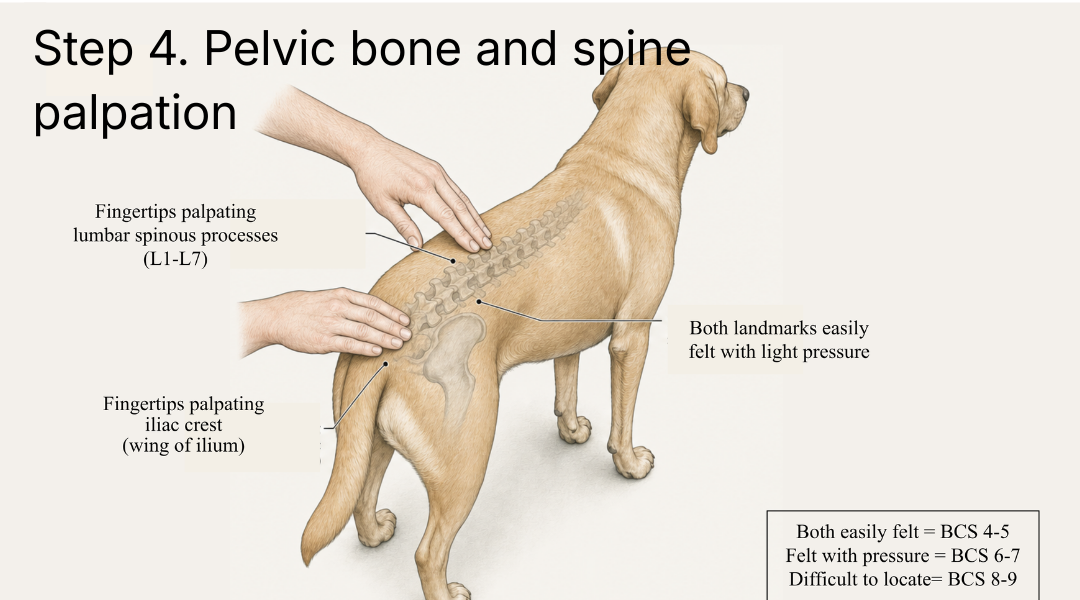
Body condition is assessed using a small set of anatomic regions, combining what is seen with what is felt. Palpation is essential because coat length, coat density, and body conformation can obscure the patient’s true adiposity.
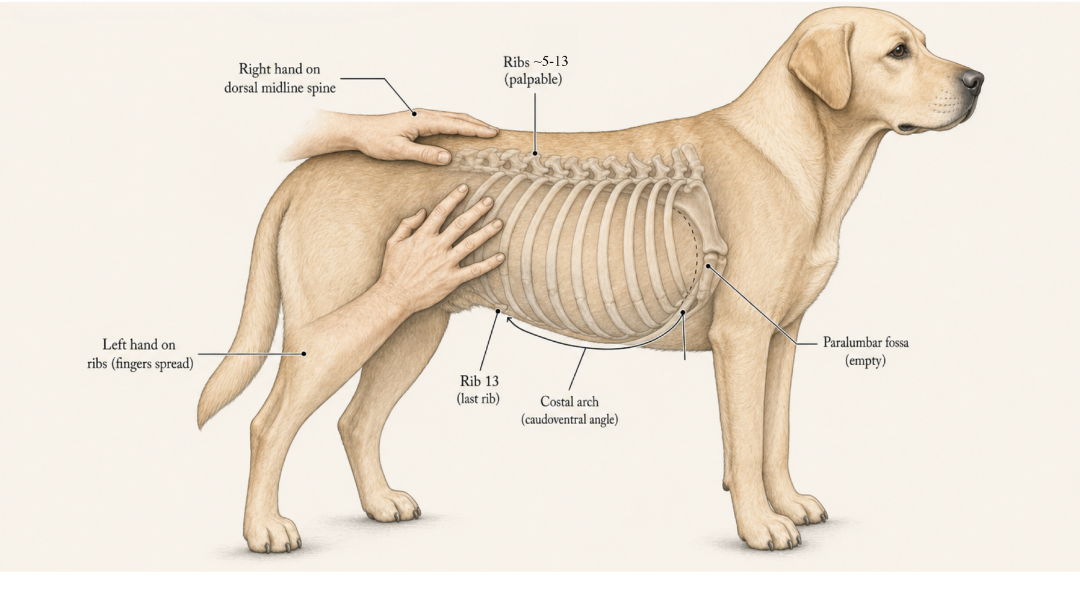
Ribs
Palpate along the chest wall. In ideal body condition, the ribs are easy to feel beneath a thin layer of fat, without being sharply prominent or difficult to detect.
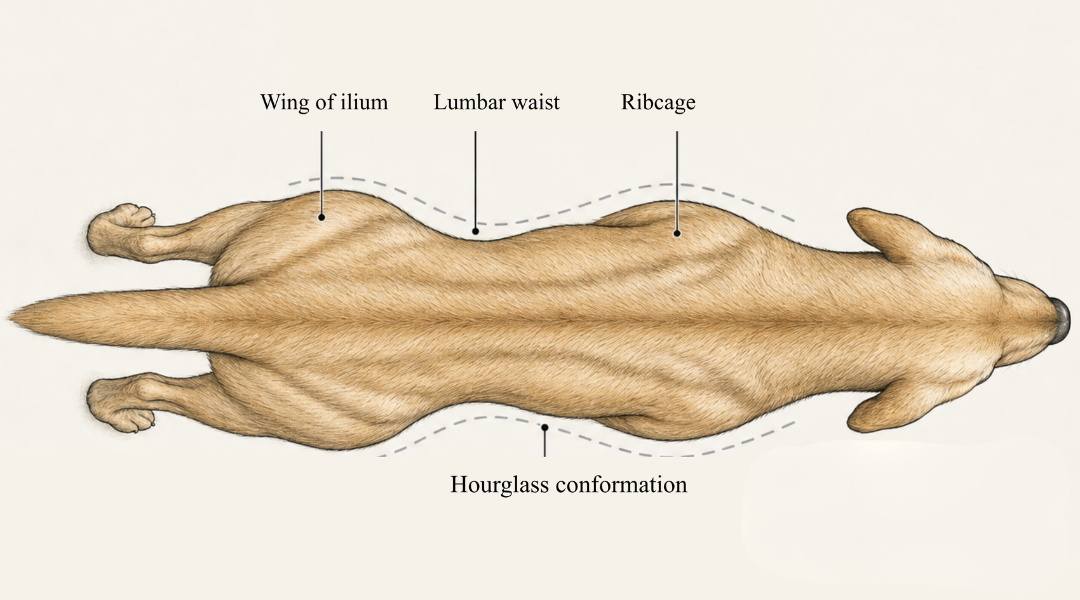
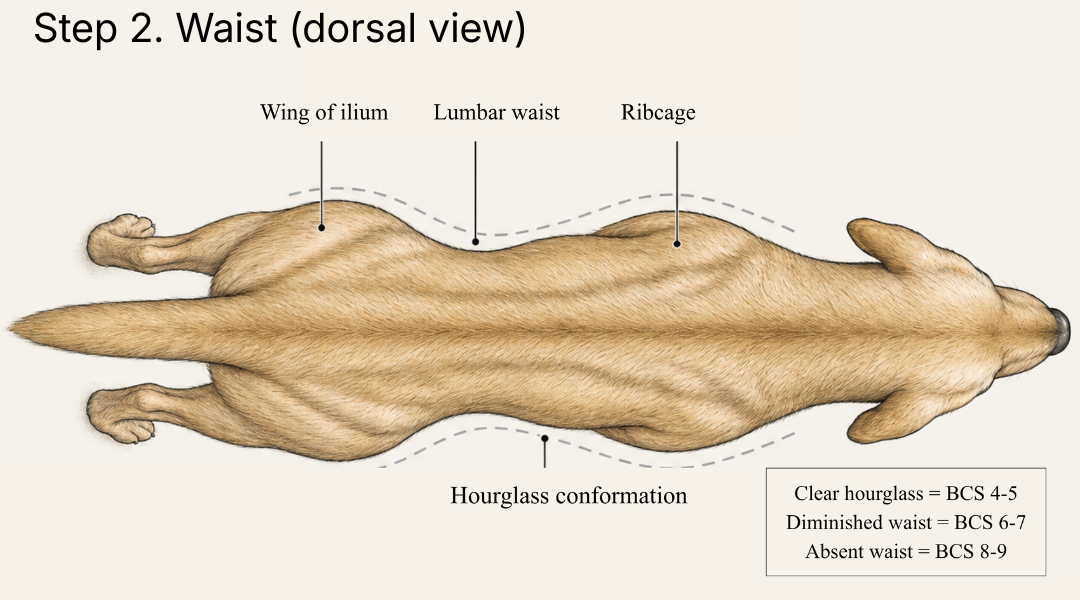
Waist from above
View the patient from directly above. In ideal body condition, the waist narrows behind the ribs and remains visible without exaggerated bony prominence.
In cats, assess the waist together with the abdominal profile and abdominal fat pad.
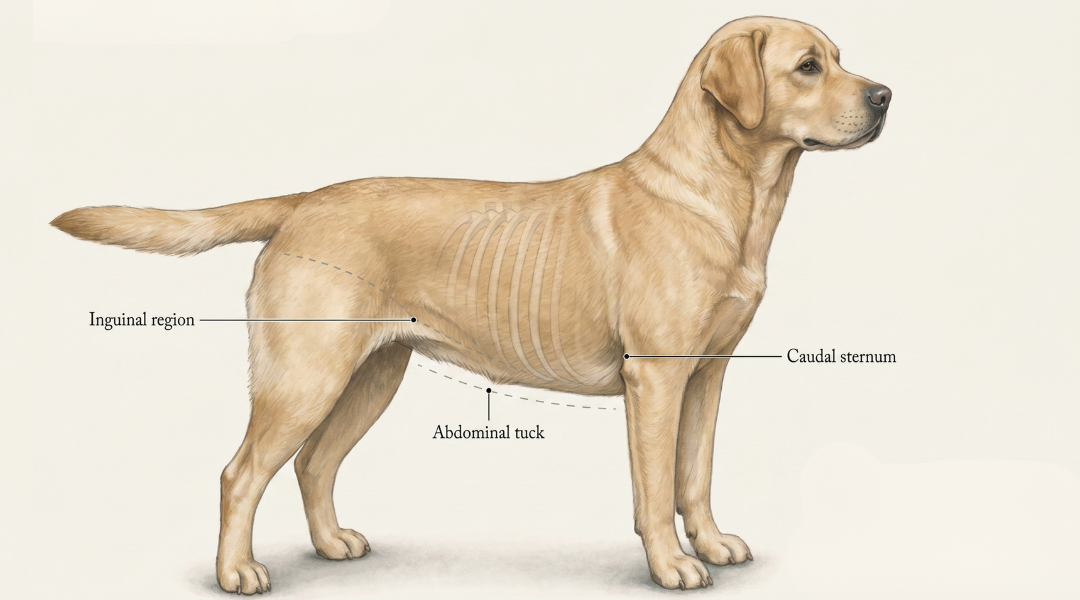
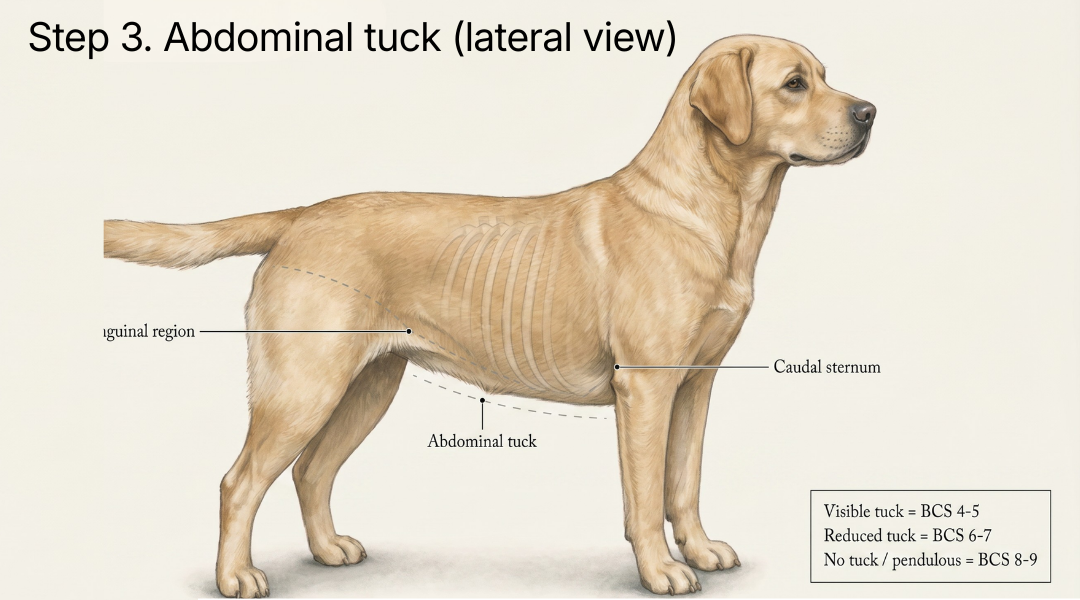
Abdominal tuck from the side
View the patient from the side. In ideal body condition, the abdomen rises from the chest toward the hind limbs, creating a visible abdominal tuck.
Many cats have a primordial pouch. Assess overall fat coverage and abdominal contour rather than the pouch alone.
The 9-Point Scale
From thinness to excess adiposity
The 9-point scale groups patients into three broad categories. Scores below ideal suggest reduced fat reserves; scores above ideal indicate excess adiposity. Ideal body condition is generally BCS 4–5/9, with most cats at 5/9.
Below ideal
1–3Fat reserves are reduced. Ribs, spine, and pelvic bones become progressively easier to see and feel, with minimal soft tissue coverage. Lower scores should prompt evaluation for inadequate intake, disease, pain, or other underlying causes.
Ideal
4–5Ribs are readily palpable beneath a thin fat covering, the waist is visible from above, and an abdominal tuck is present in profile. Most dogs sit at 4–5/9 and most cats at 5/9. Individual targets vary with breed, conformation, and life stage.
Above ideal
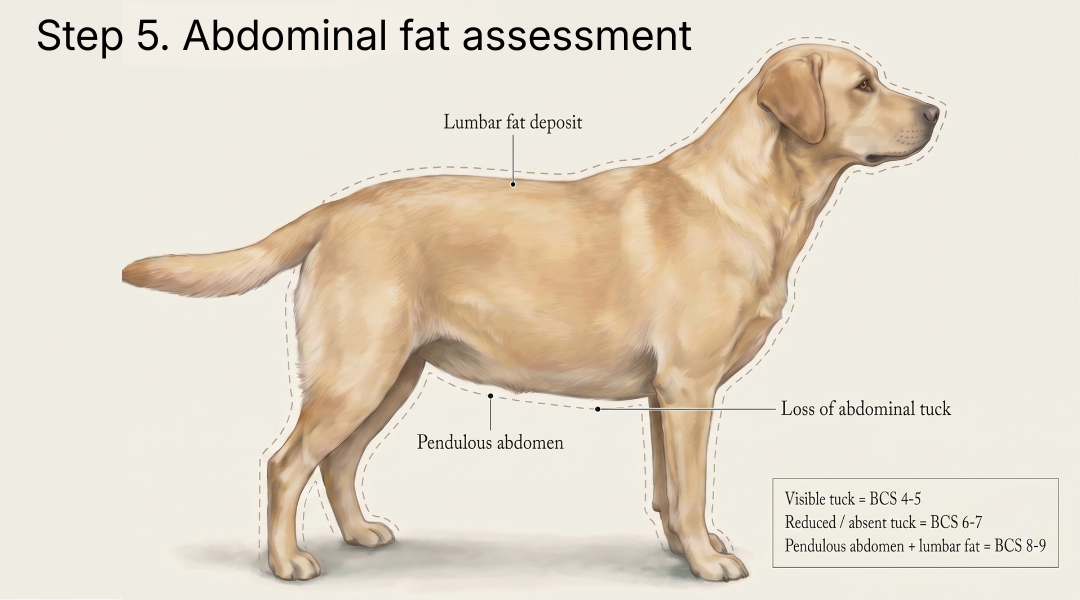
6–9Fat coverage increases, the waist and abdominal tuck become less visible, and adipose deposits may be evident over the ribs, lumbar area, tail base, or abdomen. The upper scores, 8–9/9, are consistent with obesity and usually warrant a structured weight-management plan.
Clinical note: Ideal body condition differs by species. Individual targets also vary with breed, conformation, life stage, and clinical context, and should be set by the attending veterinarian.
Performing the Assessment
A consistent, repeatable approach
Body Condition Score is most useful when it is performed consistently at each visit and recorded with Muscle Condition Score, body weight, body weight history, and relevant clinical findings.
Observe from above and the side
Assess the waist from overhead and the abdominal profile from the side before palpation.
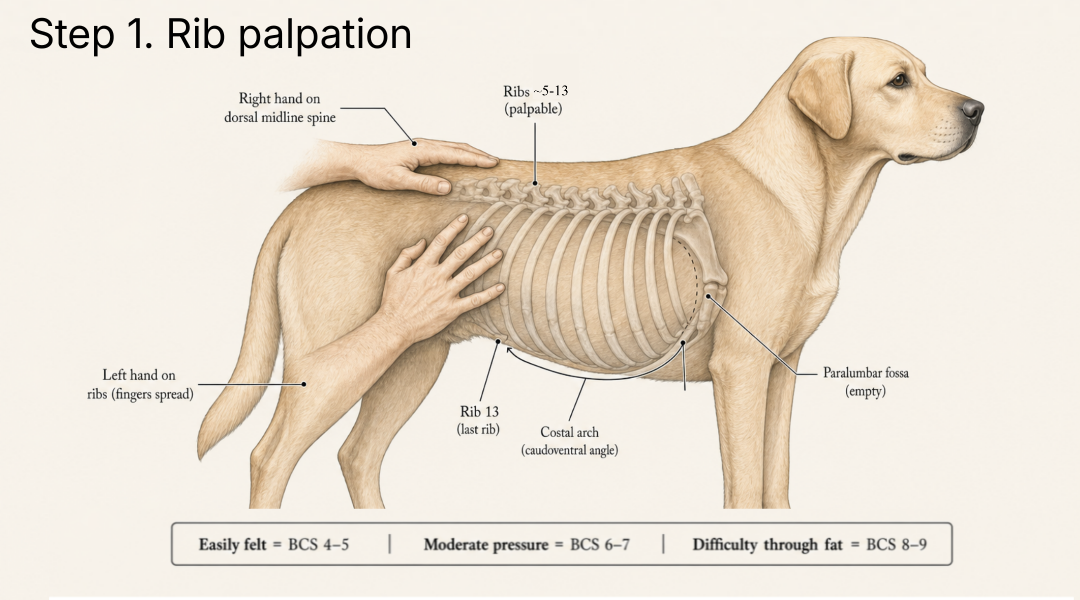
Palpate the ribs
Feel along the chest wall and note how easily the ribs are detected beneath the fat covering.
Assess fat-deposition areas
Evaluate fat coverage over the ribs, lumbar spine, tail base, and abdomen.
Assign a 1-to-9 score
Use species-specific descriptors to translate visual and palpation findings into one score.
Record with MCS
Document BCS with Muscle Condition Score and body weight to distinguish adiposity from lean tissue status.
Monitor trends over time
Repeat scoring at routine visits. Changes over time are often more useful than one score.
Step by Step
Visual scoring guide
Five illustrated steps for performing a body condition assessment. Toggle between dog and cat for species-specific guidance.
Interpreting the Score
From a score to a diagnosis
Body Condition Score estimates adiposity; it does not, on its own, establish a diagnosis. Body condition tells you how much excess adiposity is present, not whether that adiposity has begun to cause harm. That distinction is the basis of the clinical obesity framework.
Body condition is within the target range. Ribs are easily palpable beneath a thin fat layer, with a visible waist from above and an abdominal tuck in profile.
Excess adiposity is present, but obesity-related dysfunction is not established by body condition alone. Counsel and monitor; at BCS 7/9 or with clinical concern, begin obesity-focused assessment.
Excess adiposity is confirmed, but clinical classification is not yet complete. Perform appropriate assessment and apply the Three A’s to determine preclinical or clinical obesity.
Excess adiposity is confirmed, but organ function remains preserved and no functional impairment is documented. This is a critical window for early intervention.
Excess adiposity is accompanied by documented functional impairment attributable to that adiposity. This is a chronic illness warranting comprehensive medical management.
Clinical distinction: Preclinical and clinical obesity share the same degree of adiposity. Only the presence of measurable harm separates them.
The three A’s of clinical obesity
Clinical obesity is diagnosed only when all three are present.
Excess body fat is confirmed, typically at BCS 8–9/9.
A clinically meaningful functional impairment or organ dysfunction is present.
That abnormality is plausibly caused by the excess adiposity, after considering other explanations.
Clinical Caution
Coat and conformation can mislead the eye
Coat length, coat density, and breed conformation can obscure excess adiposity or exaggerate thinness on visual inspection alone. Palpation remains essential, and scoring should account for normal variation among breeds, body types, and species.
English Dog & Cat Charts
Choose a detailed chart or a simplified guide
Use the detailed 9-point charts for clinical scoring, documentation, teaching, and printing. Use the simplified guides for quicker pet owner conversations and at-home visual reference. The simplified guides are available in English only and are not currently translated.
Detailed dog and cat BCS charts
Full 9-point clinical criteria for closer assessment and consistent documentation.
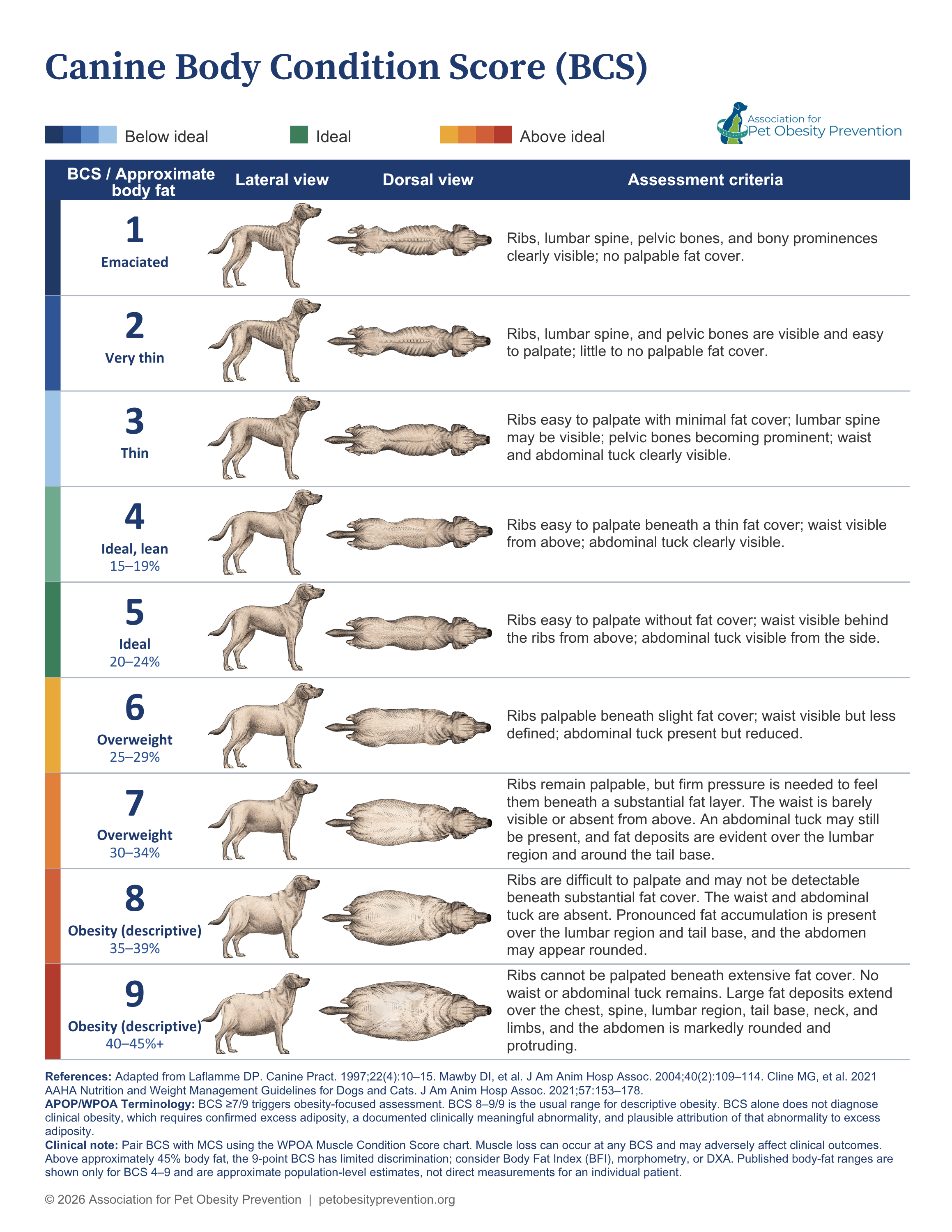
Dog Body Condition Score chart
Clinical reference with score-by-score visual and palpation criteria.
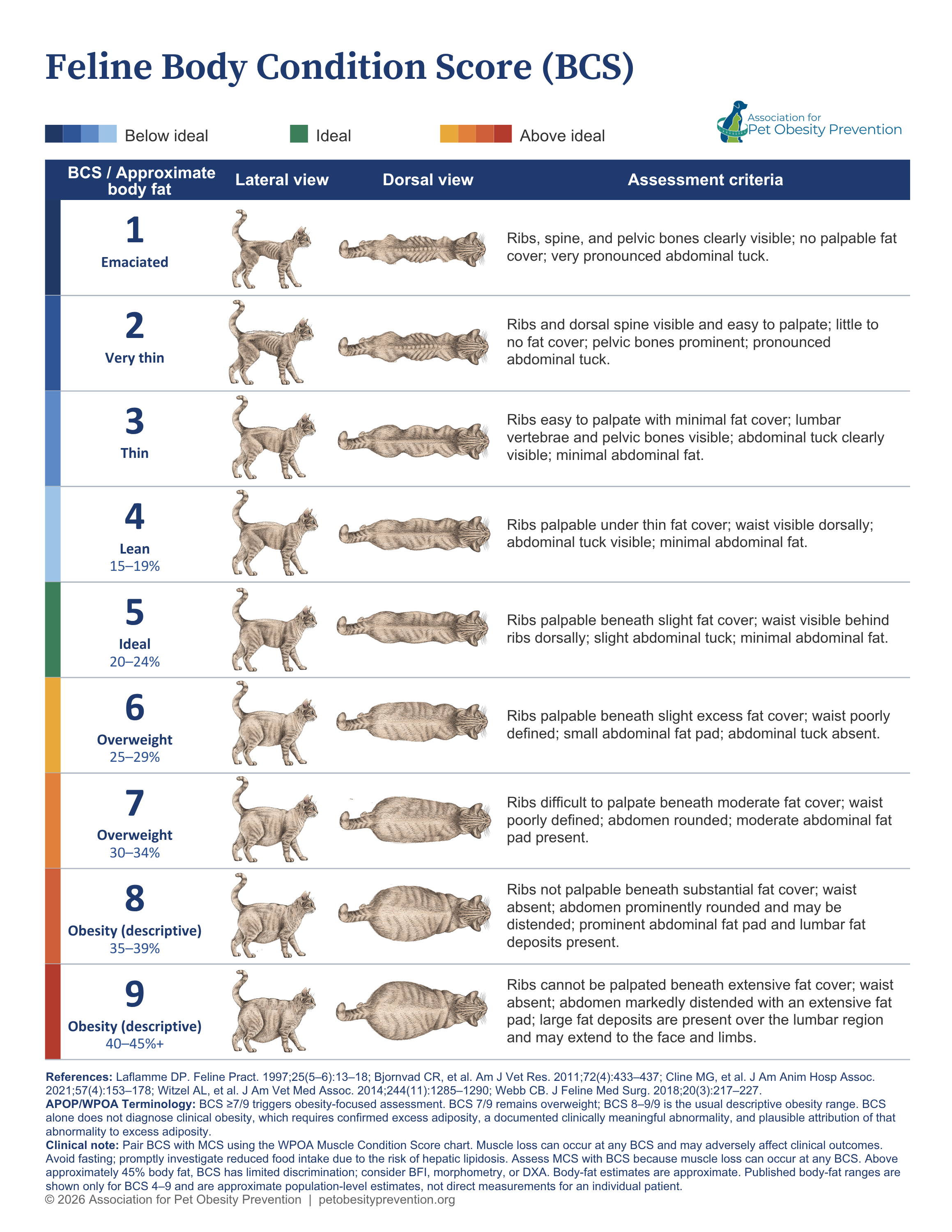
Cat Body Condition Score chart
Clinical reference with feline-specific score descriptions and assessment criteria.
Simplified dog and cat BCS guides
Plain-language visual guides for pet owners and quick clinical conversations. English only.
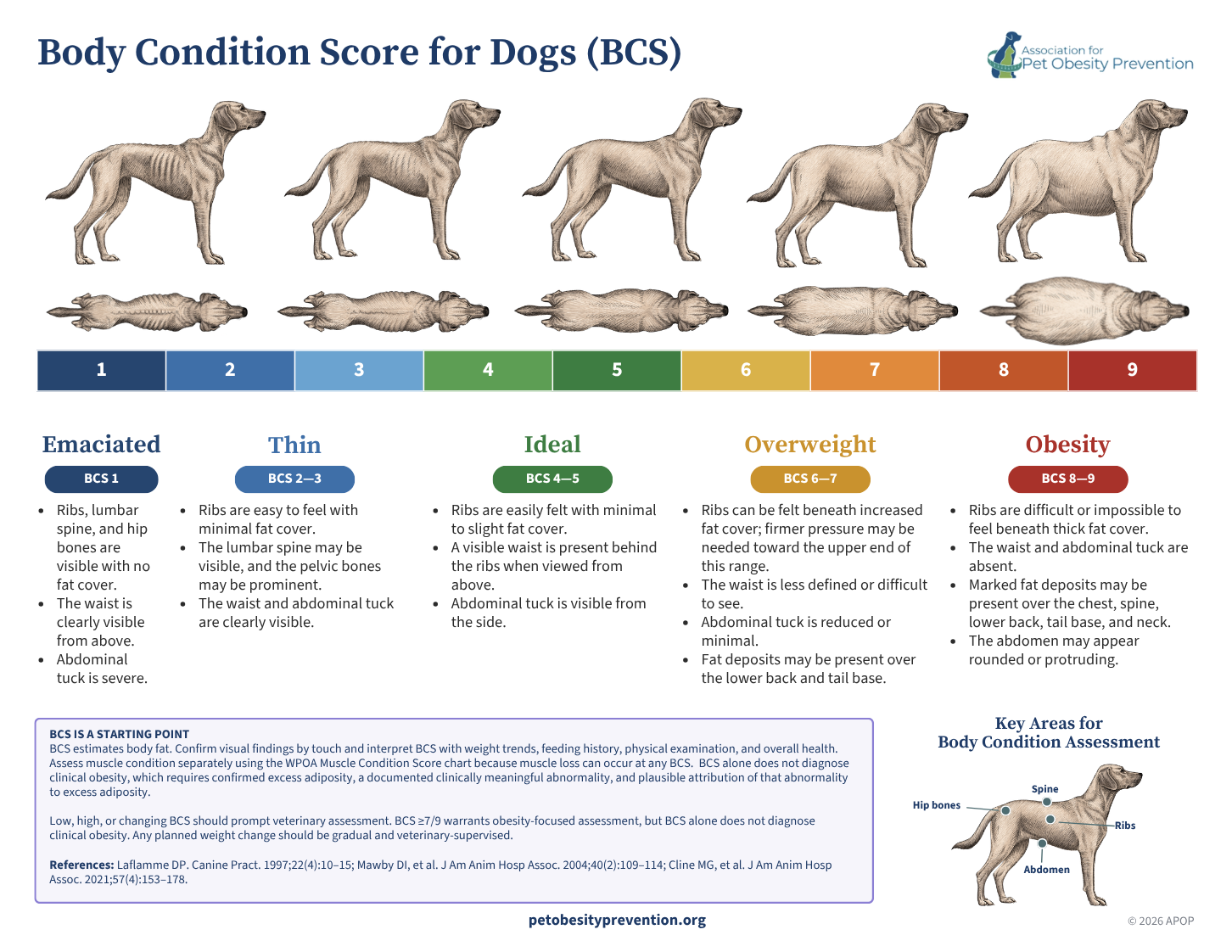
Dog BCS quick guide
Accessible visual reference for pet owners and at-home body condition checks.
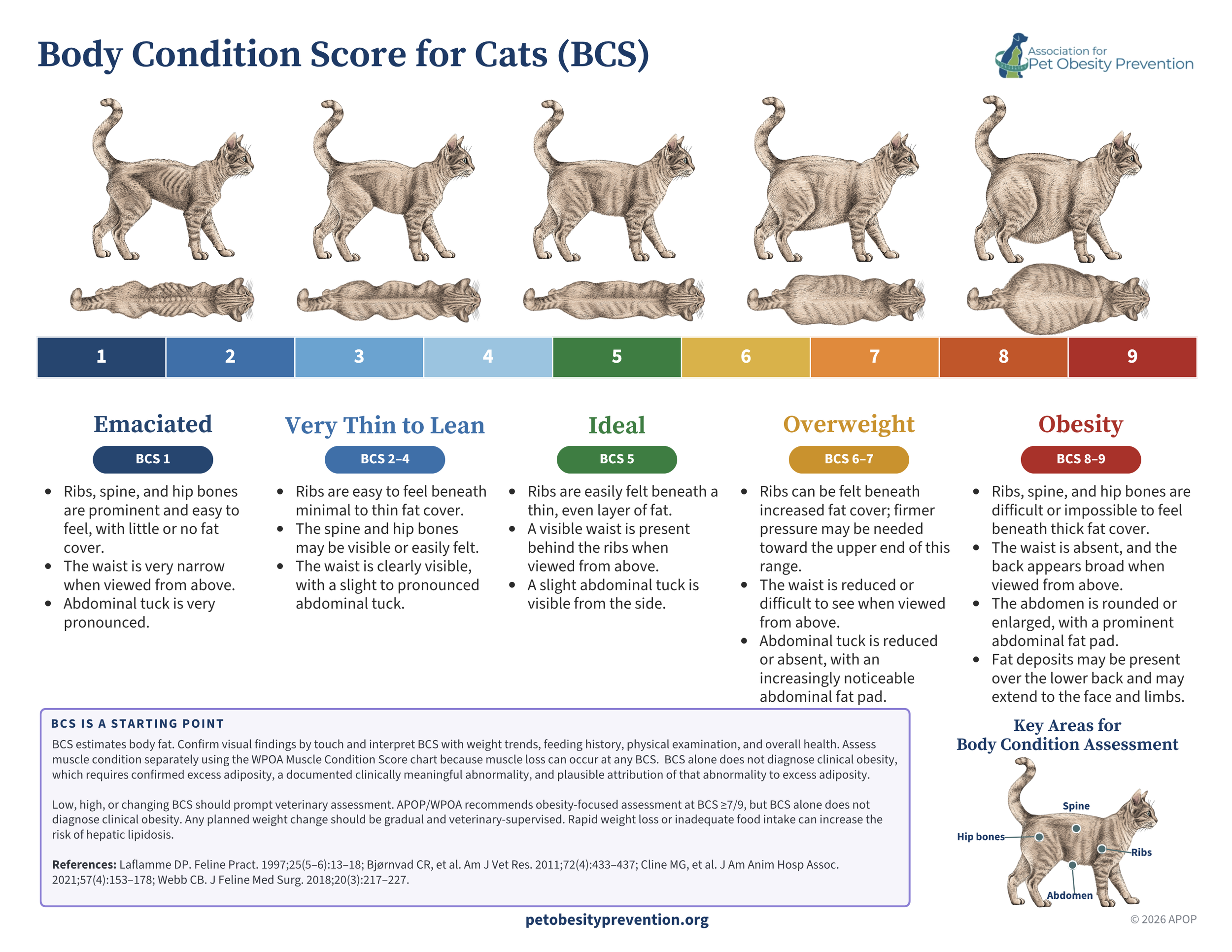
Cat BCS quick guide
Accessible visual reference for pet owners and at-home body condition checks.
Looking for another species? This clinical guide remains focused on dogs and cats. Rabbit and horse BCS charts are available in the BCS & MCS Chart Library.
BCS & MCS Chart Library
Need another language or chart type?
Use the dedicated chart library for translated detailed dog and cat BCS charts, dog-and-cat Muscle Condition Score charts, and rabbit and horse BCS resources. Simplified BCS guides are English only.
Related Resources
Continue with these clinical tools
BCS & MCS Charts
Download translated Body Condition Score and Muscle Condition Score resources from the central chart library.
Open the chart libraryMuscle Condition Score
A standardized framework for assessing skeletal muscle mass, designed to be recorded with Body Condition Score for a more complete clinical assessment.
View the MCS guideCalorie & Weight-Loss Calculators
Structured tools that support energy estimation and weight-management planning, interpreted alongside body condition, muscle condition, and clinical findings.
Open calculatorsClinical Obesity Framework
A structured approach to defining, diagnosing, and monitoring obesity as a chronic clinical condition in companion animals.
Read the frameworkAbout this tool: The Body Condition Score framework is intended for veterinary education and clinical discussion. It should be interpreted alongside Muscle Condition Score, body weight history, medical history, clinical signs, and a complete physical examination.
About body condition scoring
Body Condition Score, or BCS, is a standardized scoring system used to assess body fat in dogs and cats through visual evaluation and hands-on palpation. WPOA provides BCS education, scoring guidance, and downloadable body condition score charts in multiple languages to help veterinary teams, educators, researchers, and pet owners recognize underweight, ideal, overweight, and obesity-range body condition more consistently. These resources support clearer clinical documentation, better communication with pet owners, and more consistent use of BCS in everyday veterinary care around the world.